Copyright © IJCMAS ICMAUA. All rights
reserved
# 9. 2009
The international Journal of Combat Martial Arts and Sciences
ICMAUA
Current articles (All rights reserved by authors):
BLACK
LOTUS FOUNDATIONS: Donald Miskel (03.2009)
CENTERING:
Donald Miskel (03.2009)
BUILDING ON
THE BASICS: Donald Miskel (04.2009)
EMBRACING THE
ATTACK OF THE TIGER: Donald Miskel
(04.2009)
BLACK LOTUS:
FORM, FUNCTION AND FOCUS: Donald Miskel (05.2009)
THE
REINVENTION OF SELF: Donald Miskel (05.2009)
TEACHING TODDLERS MARTIAL ARTS: J R Lee-Barron (06.2009)
INSTITUTE OF
MARTIAL ARTS AND SCIENCES ANNUAL CONFERENCE: J R
Lee-Barron (07.2009)
TRAINING IN THE NOJO: Donald Miskel (08.2009)
REAL WORLD MARTIAL ARTS: Donald Miskel
(08.2009)
THE APPLICATION OF
ACADEMIC RESEARCH IN THE
MARTIAL ARTS AND SCIENCES: J R Lee-Barron (08.2009)
THE MOMENT
OF CONTACT: Donald Miskel
(08.2009)
STRENGTH
VERSES POWER: Donald Miskel
(08.2009)
8th-
MASTER ZUBAIRIS TAEKWONDO CUP 2009: Rizwan Mustafa
Zubairi (08.2009)
BISON SYSTEM: Ritesh Reddy (10.2009)
HOW THE PRINCIPLE OF AIKI RELATES TO HAPPO NO KUZUSHI: Martin Ramirez (11.2009)
THE IMPORTANCE OF ATEMI-WAZA:
Martin Ramirez (11.2009)
UNARMED AGAINST A BLADE: Donald Miskel (11.2009)
RENSHIS,
SHIHANS AND HANSHIS (OH MY): Donald
Miskel (11.2009)
BLIND FURY: Dan Edwards (12.2009)
BLACK
LOTUS FOUNDATIONS
Donald Miskel
Since we are adding new
members who share a common vision, I would like to elaborate on the foundations
and philosophies of the Black Lotus Martial Art Systems and some of its
underlying principles. We may not all share the exact same fighting system but
we do have to be on the same page as far as direction is concerned. After all,
“how can two walk together except they be agreed”? (Amos 3:3)
Black
Lotus Martial Art System is an eclectic interpretation of a number of fighting
principles and concepts. It takes its primary techniques from karate (Okinawan
Kempo), American kenpo, Aikijitsu, and Chinese Chaun Fa and Chin Na. Though we
follow an eclectic approach, each of these systems are separate entities and
can be studied and ranked separately.
Goju
Te Kempo is the foundation of the Black Lotus system. We feel that striking is
the most effective way of dealing with combat and self defense situations. The
grappling techniques that we use are generally used as restraint or throwing
techniques at the end of a waza (fighting combination or sequence). They are
not generally used as singular fighting techniques on their own, but supplement
the primary striking techniques.
Goju
Te Kempo gives us a flexible system that deals with aggression by redirecting
the force of an attack and using it against an attacker. We try to avoid using
force against force and will preferably use soft circular blocking that
redirects the direction of the attack and positions the opponent a
disadvantageous position. We use sabaki or positioning footwork, to place our
self in the most efficient position to deal with an attack while offering the
least access to the opponant’s weapons.
The
Black Lotus System uses seventy percent hand (striking) techniques to twenty
percent kicking and ten percent grappling techniques. Of course, since the
system allows individual interpretation by the practitioner, these percentages
may vary somewhat.
Our
system uses about an equal percentage of open and closed hand attacks, again
varying with the individual. We prefer strait line punching to circular, though
both are used. Our open hand and arm strikes are generally circular, though
again, a few strait line techniques can be and sometimes are used. Our kicks
tend to be directed to an area from the solar plexus and rib cage to the feet,
ankles and lower legs of the opponent. The system also incorporates leg and
foot trips, sweeps and entanglements to destroy the opponant’s balance and
attack his base. Kicks are not generally used as a primary technique. More
often it is used to set an opponent up for a finishing technique, to divert his
attention from a primary technique, as a supplement to a series of hand
techniques, or as a finishing technique at the end of a waza.
Along
with striking, kicking and grappling techniques, we use a series of bone and
joint destruction, ripping and tearing techniques, and techniques designed to
break the neck or the spine. These techniques are used for extreme situations
and are not first choice techniques. They are designed for killing, maiming or
seriously injuring an opponent. We also employ a number of choking, strangling
techniques and sleeper holds, as well as a number of restraining holds and
locks.
We
will use nerve center and pressure point attacks, but our primary aim is to
destroy the support system (feet ankles or legs), obscure or destroy the
vision, or to compromise the opponent’s ability to breath. This gives us a
number of easily accessible targets that don’t require a lot of technical skill
to access.
Aside
from these offensive weapons, we employ
a number of more exotic weapons, such as the shoulders, hips, butt, the
chin, head, and teeth, as the situation may warrant.
Living in the modern
world we also teach the use of weapons. Those who desire are taught kobuto, the
use of traditional Okinawan and Japanese weapons. All students are taught the
use of bladed weapons, striking weapons, firearms and weapons of opportunity.
Students are also schooled in weapon defense, multiple opponent defense and
scenario defense situational drills.
Our
basic self defense system advocates gross motor movement and simplicity of
technique. Though more complex techniques are taught to the advanced students
we believe in erring on the side of simplicity.
Our
defensive system tends to be deceptively simple. We avoid force to force blocks
unless we are using a block as an attack on the opponants offensive limb. When
using an attacking block we will try to direct it to the most vulnerable area
of the opponant’s attacking limb while cutting his line of attack to use his
force against him. We prefer parrying or circular defenses to force on force
blocks. Our blocks are used along with footwork and body positioning to place
the opponent in a position that doesn’t allow him an angle of attack, and makes
it difficult or impossible for him to defend himself. They serve to unbalance,
overextend or uproot him while placing him in a vulnerable position. They allow
us to either strike simultaneously with our blocks or strike an indefensible
area following the block or parry.
Though
we train in a martial discipline, we are a Christian based martial art system,
which means we exercise Christian restraint when confronted with a threat. We
will fight but only when there is no other alternative. Our philosophy
concerning conflict resolution is base on these premises. We will walk away
from a fight if possible. We will try to reason our way out of a confrontation,
deescalating or diffusing the situation if we possibly can. If forced to fight
we will restrain rather than hurt, hurt rather than injure, injure rather than
maim or cripple, and maim or cripple rather than kill. We will kill only if it
is completely necessary and we are left with no alternative.
Our
system incorporates several basic kata to teach flow, body movement and
footwork, and to promote balance. More than kata, waza are taught to program
basic movements, defensive techniques and incorporate responses into muscle
memory. Static repetition of basic techniques are used in the beginning, to
teach the student the techniques and to teach the proper body dynamics, but
they are generally used only in the
early stages. In the intermediate stages, basics are practiced through the
wazas.
Within
the Black Lotus Martial Arts Association, there are a number of individuals who
teach complete systems. While they may not mimic the Black Lotus Fighting
system they embrace the concepts and basic principles in the application,
expression and use of their individual systems. Each student must invent
himself and find his own way after having perfected the basics. They are given
a large pool of knowledge to draw from and within this environment, governed by
the core principles, concepts and philosophy builds his own approach that suits
his needs and purposes. I don’t want those who align themselves with me or
train under me to be clones of me. I will give them the building blocks but
what they build with it is up to them.
Each
master and sensei is autonomous and teaches his own system, but we share common
ideals, goals and philosophies. In the end, the Black Lotus Organization
doesn’t promote a single system, but embraces many styles that seek a common
goal; The growth, proper education and implementation of our arts, and the
proper approach in the use of our knowledge and ability.
This
ends this brief explanation of our approach to the fighting arts. This has been
an overview of out philosophy and approach to the martial arts. I hope it has
given some insight into our ideas, philosophy and approach to the martial
disciplines. These precepts are used as guidelines, not as set laws. As long as
the individual member governs himself by responsible Christian rules of conduct
and trains honestly and realistically, he has the flexibility that allows
individual expression.
Lastly let me say that
what we teach isn’t a sport. It doesn’t lend itself to competition. Until there
is a sport that advocates competitive eye gouging, joint destruction, murder
and mayhem, there can be no reasonable sports application of our fighting
system. What this approach ‘will’ do is allow each individual to become the
best martial artist he can be and if necessary, fight or defend himself and his
loved ones.
In conclusion I would like to quote a couple of
scriptures that illustrate our Christian
philosophy and should serve as a guide in our endeavors.
“Seek
ye first the kingdom of God and his righteousness… (Matthew 6:33)
“In
all thy ways acknowledge Him and he will direct your path.” (Proverbs 3:6)
“Follow
peace with all men and holiness without which no man shall see God.” (Hebrew
12:14)
God
bless you my Brethren. Train hard and go with God.
CENTERING
Donald Miskel
I have
often been asked why do I, as a Christian minister, continue my studies of the
martial arts. To date, I have put close to fifty years of study into training
in something that I hope never to have to use. One of the answers I give most
often is, “to stay balanced”.
I’m
not huge but at five nine and carrying
So why
do I persist in my training? I can give you several reasons. For one, studying
the martial arts and doing the additional training that allows me to continue
these pursuits, have kept me in pretty decent physical condition, even into my
sixties. Another benefit is that it has helped to minimize the debilitating
effects of aging. I’m not twenty years old and I can’t do what I was one able
to do, but considering my age, I manage to do more than most. To a large
extent, we don’t just get old. What we do is relinquish our youth and give in
to old age. We don’t have to do this. If we stay active, and train properly
we’re capable of doing much more than we might think. Another reason for
continuing to train is it to stay centered.
I
don’t study the martial arts simply as a means of trying to find some form of
enlightenment. This is what the ‘do’ in the martial arts, such as in judo or
aikido, implies. I lean more towards a ‘jitsu’ approach. ‘Jitsu’ alludes to a
more combative application. I don’t continue my studies anticipating a fight or
an attack that may never happen, but I do believe in being combat able.
Actually, whether we study the martial arts as a ‘do’ or a ‘jitsu’, there are a
number of benefits that the martial arts offer beyond trying to turn ourselves
into the proverbial lethal weapon. Centering is one of these benefits.
Most
martial arts address this concept to a greater or lesser degree. In some arts,
especially the internal arts, such as Tai Chi, Pau Kua, Hsing I , Aikido and
etc., centering is emphasized. In some of the other martial arts, it isn’t
taught as an individual concept, but in training, it is gradually instilled
into a student.
Centering
means more than the occidental interpretation of this word might imply.
Centering takes several things into consideration. Centering implies balance.
It means that a person must always be aware of his center of gravity and, for
the most part keep it directly under him to remained balanced. It also requires
a lowering of the center of gravity to accomplish rooting, making it difficult
to unbalance, upset, or move the person. Balance also requires proper
positioning in relationship to an opponent. It can mean being at the right
angle to address an attack, or avoiding the direction of the attack. This
implies, being at the right place at the right time. This allows a martial
artist to redirect and contain a threat without exposing himself to undo
physical danger. Balance also requires proper breathing. To remain balanced, a
martial artist has to breathe from the diaphragm, expanding the entire area of
the lungs. Aside form the fact that this oxidizes and energizes the body, it
keeps the person from floating his body, or raising his center of gravity. This
is often caused by breathing in just the upper portion of the lungs or by
expanding the chest, raising the center of gravity. We have to keep in mind
that since the center of balance is a few inches below the navel, it is more
important to concentrate on and possibly extend the belly to lower the center
of gravity. Floating interferes with stability and makes the balance weak. With
weak balance it is impossible to be efficient in facing the opposition that life’s
threats bring with them.
Incidentally,
balance figures in other areas of our lives. Man is a triune being, and to be
balanced, in a holistic manner. means that each aspect of the person is in
balance with the other. Training in the martial arts aids in attaining this.
Man is
first a spirit. It is in this aspect of a man’s being that he is able to have a
relationship with God. We are told in the word that, “God is a spirit, and they
that worship him must worship him in spirit and in truth” (John 4:24). Man’s
being should be centered first in his spirit. The word says, “They that are
after the flesh do mind the things of the flesh, but they that are after the
spirit, the things of the spirit” (Romans 8:5). Being centered in the spirit
implies denying the lust of the flesh. Of course, this is accomplished by
seeking and growing closer to God through Christ, but it also requires
sacrifice and discipline. Studying the martial arts will not necessarily make a
person more spiritual, but it will offer some of the discipline necessary to be
successful in this aspect of his life. As advised by Solomon, we acknowledge
God in all that we do and we allow him to direct out path.
Secondly
man is a soulish being. The soul is the intellect or the seat of consciousness.
In a sense, the soul is who we are. It is how we see ourselves and how we
perceive the world. In this area of our existence, we have our sense of self
awareness. The soul determines the priorities in our lives and the choices we
make. It is through the soul that we will decide to live with emphasis in
either the carnal or the spiritual realm. It is in the soul that we exercise
free will. We will either decide to seek the way of the spirit and draw close
to God, to seek the way of the world which is the devil’s path, or we will try
to be completely self motivated, leaving God out of our lives, which is as self
destructive as openly yielding our lives to the devil. Without God there can be
no life and without Christ, there can be no salvation. To be centered in our
soul is to make God the center of our lives. Again, by giving us better control
of our physical selves, it gives us the discipline to deny the desires of the
flesh and the influences of a sinful world that’s rooted in the flesh. “Thou
will keep him in perfect peace, whose mind is stayed on thee.” (Isaiah 26:3)
Lastly
is the natural man or the physical aspect of our being. Man’s greatest
aspiration should be his salvation. We should understand that salvation is a
process. The Spirit is saved immediately, as soon as we give our hearts to God
through Christ. Jesus is the only source of salvation and the only path through
which we can establish a relationship with God. The soul is saved gradually as
we learn to yield our lives to God, walking according to his precepts. This is
what it means to ‘work out our salvation in fear and trembling’ as mentioned in
Philippians 2:12. The spirit and soul can be saved in this realm but the flesh
can only be brought and kept under subjection. That is why we are told in the
word that flesh and ‘blood cannot inherit the kingdom of heaven’.
As we
become centered through our martial art training, that sense of balance should
begin to permeate other areas of our lives. The martial way is a way of
sacrifice, self denial, hard work and discipline. Through this effect, we
should seek to bring the rest of our life in balance by being completely
centered.
Being
centered doesn’t mean sitting and contemplating your navel. It doesn’t require
transcendental meditation and chanting. Many of the practices of traditional
Eastern martial arts will mislead us in our Christian lives. That is why, even
in the practice of these physical disciplines, we must remain spiritually
centered. This will focus us, enable us to attain our martial art goals and
keep us in spiritual balance.
Being
physically centered can save our lives in a confrontation. It can help us
diffuse, deescalate, walk away from, or if necessary, physically deal with a
confrontation. Being spiritually centered, on the other hand, can save our
souls. We have to be centered enough to deal with every confrontation that life
sends our way, whether it is in the natural or spiritual realm. As you pursue
your studies, let me remind you; that you may or may not ever face a threat from
a physical opponent in your life time, but spiritual warfare is a constant and
universal reality. This applies whether you are a Christian or a sinner. In
that area, the devil doesn’t discriminate. He has a special dislike for
Christians but it is his desire to destroy every person he can, man, woman and
child; saint and sinner. Being a Christian doesn’t exempt you from this fight.
The truth is, he has every saint in his crosshairs, but it gives us the tools
to deal with his attacks. If there’s one thing we learn in our training it’s to
use the right tool for the job. It isn’t a good idea to ‘bring a knife to a gun
fight’. As martial artists and as Christians, we must know our enemy, be ready
for any possible attack and be centered enough to deal with the challenges that
life in this world (enemy territory) might send our way.
In
closing, let me remind you that being centered means not anticipating anything,
but being ready for everything. The enemy doesn’t always telegraph his
intentions. Be ready for whatever challenges you may have to meet, and as the
Boy Scout motto says, “Be Prepared”.
Train hard, my brethren, stay centered and go with God.
BUILDING
ON THE BASICS
Donald Miskel
Way
back in the day when I was a kid (some of my students will think that that was
in the beginning of time), my father took me to downtown Chicago. He showed me
a construction site where they had dug the deepest hole that I had ever seen.
It looked to me like they had dug to the very center of the earth.
I
asked my father why they were digging such a big hole. He told me that they
were going to build, what was to be, the tallest building in Chicago. No, I’m
not talking about the John Hancock Building or the Sears Tower. I may be dating
myself, but I’m referring to the Prudential Building.
I
wondered why they were digging a hole if they wanted to build a tall building.
It didn’t make sense to me. Being only a child, I didn’t understand the need of
a solid foundation in building. Unfortunately, a lot of Western martial artists
suffer from the same short sightedness. They want to build tall, without
digging deep.
Christ
told the parable about the man who built his house on the sand. It stood quite
secure until the rains came and the storms raged. Too many of us find ourselves
in a similar situation. Our martial art skill is fine as long as we aren’t
faced with any real opposition. You may ask yourself why this is. It can stem
from any of a number of reasons. It can be a lack of native ability, or
physical skills in a person. He can lack the reflexes or the needed eye hand
coordination needed. Some people are strong and have the musculature that is
complimented by slow twitch muscles. They are physically powerful, but they
lack speed. Some people, on the other hand, are long and lean and have the type
of speed that results from fast twitch muscles. Some people are uncoordinated
and clumsy. Some have poor balance. All of these, and other similar problems,
can hinder martial arts skill. Many of these can be overcome with diligent
training, but some are just the problems that we have to deal with as we seek
success as martial artists.
There
are some facts that have to be accepted. If you’re short, you can’t make
yourself tall. If you’re naturally thin, you can’t make yourself large. Your
bone structure, height and general body configuration are governed by genetics.
If you’re short and heavy boned, Taekwondo may not be your best choice in the
martial arts. If you’re thin and small boned, you might not want to dedicate
your time to grappling and ground fighting. People have overcome these
limitations, but I’m a firm believer that you should choose your martial art
according to your limitations and body type.
Some
of the challenges that we face in becoming competent martial artists are
inherent but some are self imposed. If you’re uncoordinated, training can
remedy some of that problem if you’re determined in your goal and stick with
your training. We struggle with our limitations and natural lack of ability,
and many overcome them with time and determination. We have to be realistic in
our training. We have to work with, and sometimes work around, the things we
can’t change, and we have to change those that we can.
The
western mindset has changed the way that the traditional martial arts are
taught, or at least here, in the western world. Our feeling of personal
freedom, personal expression, and entitlement, changes the traditional
relationship between instructor and student. In the birthplace of these arts,
students venerated their instructors. They didn’t question their instructors
and any doubts or disagreements they may have had they kept to themselves.
Getting
back to the analogy I was trying to make at the beginning of this study, if you
want to build high, you have to dig deep. The most important part of the
building process is laying a good foundation. Without a good foundation, it
doesn’t matter what building material you use. You can build with the best
steel and the finest brick. You can engage the finest artisans and have them
take their time in their labors, but the results will still be poor if there is
no foundation to your building.
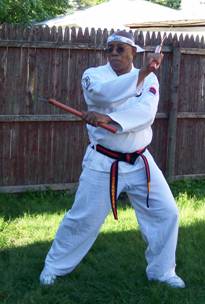
Kobudo (Sai).
In a
neighborhood on the southern outskirts of Chicago, I lived in a building
complex that was built on reclaimed land. The land had once been swamp but had
been reclaimed with landfill. Some of the buildings began to sink, over time,
and their integrity was compromised. Consequently, they had to be torn down.
Once the building has been built, it is virtually impossible to build a firm
foundation under it. That’s why it’s important to establish a good foundation
prior to building the structure.
In
these days of reality training and real life martial arts, this is as important
as ever. I put a lot of store in reality training. I teach a reality system
myself. These systems are good, if they’re built on something. Most of my
martial arts training has been devoted to the traditional arts and was based on
extensive training in the basics. When it is all said and done, it is the basic
techniques that seem to work.
Unfortunately,
many people judge a martial art by how visually and ascetically pleasing it is.
There is some truth to this concept. Form effects function. When these martial
arts are done well, the coordination, balance, economy of motion and strait
forth purpose looks graceful to the eye. Grace as a natural by product of the
arts is fine, but grace for the sake of grace is a mistake that robs the arts
of their effectiveness. Looking pretty
for the sake of looking pretty should never be our goal. We must keep in mind
that we are practicing fighting arts and not ballet.
The
problem that I have with many of the martial arts that are being taught today,
is that they are long on technique and short on basics. The system that I teach
came about in the eighties because many of the younger martial arts
practitioners were proving ineffective in the streets. It’s nice being
effective in the dojo but if it doesn’t translate to the streets, where its
martial ability is needed, it is nothing but a form of exercise, and probably
not the best form of that. If it’s only exercise that you want, you’d do better
with aerobics or strength training. The martial arts were developed for
fighting and that’s what it should accomplish best.
Personally,
I don’t view martial arts as a sport. I did some tournament fighting when I was
younger, but I quickly came to realize that many of the opponents that I
couldn’t defeat in kumite, I’d walk over in the streets. Combat, and the
reality of the inner city streets, clarified a lot of the misconceptions of
combat that I may have had. Personal combat is real. It isn’t a game. If you
face an attacker with a knife, you are either capable, or you are dead. That
isn’t the time or place to try to learn martial skills. If you aren’t able to
give a realistic and effective account of yourself, you very probably won’t
live to learn from the experience.
I grew
up in tough surroundings and rough circumstances. Combat wasn’t theoretical. It
either worked or it didn’t. I saw too many, would be, martial artists, left
bleeding and broken in the streets. In those types of encounters, fancy and
complex techniques don’t work. In my experience, it wasn’t the rear spinning
heel kicks or the flying side kicks that got the job done. It was the shuto
(knife hand) to the throat, the reverse punch to the solar plexus, the stomp
kick to the knee that was effective. The
basics are what work. The simpler a technique is the more chance that it will
actually work.
I’ve
had the misfortune of having to face attackers with knives, clubs and even
guns. I was fortunate to survive these experiences, but you can rest assured
that there wasn’t a fancy technique to be seen during these encounters. I
resorted to the ten thousand block and counters that I had done in the dojo to
see me through these experiences. Too often today, fancy techniques are taught
to green students. They haven’t had the basics burned into their muscle memory,
and though they may know the techniques, they can’t use them when they are most
needed. I don’t care what martial art you practice, there is no effective
fighting art without basics. Like a house without a foundation, it is destined
to fail.
When
the system that I teach was founded, it was to address the ineffectiveness of
the black belts that the local martial arts were producing. Commercial schools
catered to the desires of their students to remain financially solvent. Loss of
students meant a loss of income, so many sensei compromised what they taught
and how they taught it. Contracts with guarantees of black belts at the
culmination of training, became common. When I first got involved in the
martial arts, as a youth, I was told that very few students would ever become
black belts. I was told that many didn’t have the capabilities, regardless of
the length or intensity of training. I’m not saying whether I think this is
true or not, but I have seen a lot of shodans who wouldn’t have been green
belts in the systems I was brought up in. In those days, you expected to take
at least six to eight years in earning that coveted first degree black belt, if
you could do so at all. Now days, black belts are handed out in a year or two
to anyone who stays the course. Again, I’m not criticizing any style, system or
instructor, but I have a hard time seeing how a student can learn all that he
needs to know, in such a short period of time, to reach black belt level. It’s
not up to me to determine how different organizations, schools, systems or
instructors measure their students, but we should be careful about letting
students believe that they are more capable than they are. Such a mistake can
cost their lives. Reality doesn’t allow for a lot of mistakes.
I
realize that teaching methods have improved, but some things just take time. It
takes time to lay a good foundation. In Okinawa, years ago, a student didn’t
learn a lot of kata. He might learn a handful, but he would specialize in only
one. Each kata comprised an entire fighting strategy, and, according to the old
masters, mastering any one, would give a practitioner an effective fighting
system. They didn’t base their ability on fancy techniques or flamboyant
execution back then. They based their fighting arts on basics. They developed a
level of competency that is seldom seen in martial artists today. Their secret
wasn’t in superior knowledge or esoteric techniques, but strong foundations and
perfect executions of the basic technique.
Stories
are told of, long lost, secret techniques. There are no long lost secrets in
the martial arts. If it’s hidden it’s hidden in plain sight. If you want to be
a good, strong, martial artist; if you want your techniques to really work in
the streets where they are needed, you need to pay attention to your
foundation. If it doesn’t work, don’t just learn new techniques. That’s like
building additional stories on an already rickety building. Start from the
bottom up. Go back to your roots; to your beginning. A tree is strong because
of its roots. A building is strong because of its foundation. If a martial
artist is strong it is because of his basics. Train honestly, my friend. Go
back to basics.
God bless you, my Brethren. Go with God.
EMBRACING
THE ATTACK OF THE TIGER
Donald Miskel
We are
in a new era of martial arts. Many practitioners are abandoning the martial
arts as a character builder and look at it simply as an offensive or defensive
weapon. Actually, this isn’t a new view. The martial arts have simply gone full
circle and arrived again at the purpose for which they were first created.
Many
of the advocates for this approach feel that they are innovators and to some
extent they are. However, they aren’t inventing anything new. They are simply
reexploring the fighting aspects of the martial arts.
Throughout
the history of the martial arts in the U.S. there have been mavericks that were
solely interested in the combative aspects of the arts. They were criticized
and sometimes ostracized because they advocated the more violent side of the
martial arts. What these individuals had done was embrace the jitsu of the
martial arts. Though they were looked upon with distaste by the martial arts
community they were truer representatives of the original intent of these arts
than their peers.
There
are some good points in the practicality of the combative approach to the arts.
Learning to fight takes less time than the obsessive preoccupation with form
and grace. Fighting is simple and straightforward. In adapting this realistic
approach, however, we need to be careful that we don’t go so far in the other
direction that we lose some of the benefits of the classical schools of martial
arts. In many of these systems, the techniques aren’t suspect. Only the intent
and purpose of their implementation is sometime impractical.
The
classical arts aren’t so different from their combative cousins. After all, a
kick is a kick and a punch is a punch. These and similar weapons are common through
most martial disciplines. For the most part only strategy and philosophy divide
them into different arts.
One
problem with the fighting arts is that these arts are often practiced and
taught by noncombatants and even pacifists. They have no intent of ever using
what they learn in a combative situation so they aren’t overly concerned with
practical application.. There is nothing wrong with this mindset but we have to
be realistic about what we are training in and what we’re training for. Aikido,
which incorporates some very effective and potentially dangerous techniques,
has the tools to enable a fighter to hurt an opponent. However, the mindset
that is adapted in its study will not create a good street fighter.
One
thing that the classical martial arts offer is the ability to receive a
technique. In our combative intent, we become so preoccupied with offense that
we totally reject the idea of embracing the attack of an opponent. In aikido, a
practitioner is taught to make the attacker’s technique their own. They receive
and blend with the attack. They even accept ownership of the technique. When
you own something you can pretty much do what you want with it. You can put it
where you want it. Often in our efforts to
be aggressive and take a preemptive approach to combat, we sometimes throw out
the baby with the bathwater. Fighting does require some level of aggression but
aggression alone will not make a person into an effective fighter. That being
the case, considering the level of
practicality of these arts, we might as well buy assault weapons and be done
with it. Very seldom will we be as aggressive as the thugs that we will have to
face in a real fight. If aggression alone made a fighter, we would be lost
before we started. In our training, we do try to increase our level of
aggression and even develop a killer instinct, but if we sink to the level of
aggression of the street thug, we are no better than they are.
In the
long standing philosophy of karate the edict is taught; “in karate there is no
first strike”. This might sound counter productive for an art as aggressive as
karate but the problem is the lack of understanding of many practitioners and
even instructors. Karate is basically a counter punching system. It reacts to
an opponents attack and uses it to the karateka’s advantage. Modern combative
philosophy takes on an almost paranoid preoccupation with reaction time and
preemptive strikes. What they fail to realize is that if you initiate the first
strike, you are legally considered the aggressor. Of course, that is an over
simplification but unless you are threatened by a weapon or accosted by
multiple assailants you are legally at fault if you attack a potential
opponent.
Action
is always faster than reaction. That’s a fact of life that we can’t rewrite but
there are ways of dealing with this fact. One reason some martial artists fall
victim of their opponent’s fist strike is because of lack of awareness. A
person would become a nervous wreck if he walked around in a constant state of
preparedness and potential aggression. That type of mindset would translate
into a hair trigger disposition that could be dangerous in the hands of a
trained martial artist. Instead, a martial artist should be trained to be aware
of his surroundings and sensitive to what is happening around him. It is
counter productive to go through life expecting and waiting for an attack that
may never come. That type of attitude keeps the body and mind in a constant
state of tension. As any martial artist knows, you can move faster when you are
relaxed than when you are tense.
Another
way of dealing with the preemptive strike is through spatial awareness. By
keeping the proper distance between him and a possible threat a martial artist
gives himself time to react. He also allows time to evaluate the level and
intent of the threat. This should happen on a subconscious level if the martial
artist is properly trained. If you have to think about an attack your defense
isn’t going to work.
Too
many martial artists will attend a couple of seminars and think that they are
ready to take on the world. It doesn’t take long to learn a technique but it
takes time to internalize it. This is accomplished by extensive training and
repetition of a technique until it becomes second nature. Any technique, in
order to be effective, has to be programmed into muscle memory. This can only
be done through extensive practice. There is a world of difference between
knowing a technique and being able to implement it.
Another
element in effective combat and self defense is what the Japanese call sabaki.
This refers to positioning. In order to be effective in a combative situation a
fighter has to be able to position himself properly in relation to his opponent
and the opponent’s attack. Being in the right place at the right time can mean
the difference between victory and defeat. Many people have become victims
because they were in the wrong place. Avoiding certain areas will help a person
avoid being confronted by certain situations. If you insist on strolling
through a battle ground, you would do well to expect to have to fight.This same
fact lends itself to combat. Positioning is half the battle.
Another
element that enables a martial artist to be effective is total intent and
commitment. Total commitment is necessary to make a technique strong enough to
take down an attacker. This principle is called kime in karate. Kime means
focus of effort, energy and intent. A tentative technique will only get you
hurt or killed. If you don’t intend to hurt or impair an attacker, your best
bet (which often is the best tact anyway) is to take to your heels and beat a
hasty retreat. As Miyagi said in the ‘Karate Kid’, “You do karate or you no do
karate. No half do karate”. If you aren’t ready, willing and able to fight in a
compromising situation fighting isn’t your best option. You might do better to
practice track. At least, if nothing else, you can ‘get out of Dodge’.
The
last principle I would like to explore is the one that this article is intended
to address; receiving a technique.
In
trying to address agression we sometimes become obsessed with avoiding or
stopping an attack. That’s understandable considering the lethal intent of an
opponent’s attack, but sometime, in our fear of being hit we defeat our own purpose
and in the process lose the opportunity to dominate and dispatch the opponent
with the least risk of harm to ourselves.
In
combat it is a bad idea to go toe to toe, blow for blow with an opponent.
Especially since most attackers won’t choose a victim that they feel is an even
match. More often than not, you’ll be facing a bigger or stronger opponent, one
that is better armed or multiple opponents. This fact should govern our
response to an attack. If we can put the opponent in a position where he is no
longer a threat and can at the same time place ourselves in the position to do
maximum harm with minimum risk to ourselves, we have the potential to end the
conflict without being injured or hurt.
The
occidental mind views things differently from the oriental mind. Our way of
seeing things often gives us the wrong understanding of what is actually
beinging taught with some techniques in the Asian combative arts. One such
misconception is in the art of age uke, or what the westerner would call
blocking techniques.
Let me
clarify the concept of age uke. When I was studying karate I had the privilege
(and what some would consider the bad luck) of being my sensei’s uke. When
practicing or demonstrating a technique, there is tori who implements the
technique, and uke, who receives it. You’ll notice that I said receive the
technique. In order to learn a technique, there has to be cooperation between
tori and uke. This cooperation doesn’t involve opposition. Uke doesn’t oppose
tori’s technique. He receives it. This sense of receiving the aggression of an
attacker is what is implied by age uke.
In
order to really take control of an attack the defender must embrace it. He has
to receive the technique and make it his own. In so doing, he can position
himself and his opponent where it affords the best advantage. Age uke should
redirect the opponent’s attack, overbalance him and put him in a position where
the defender can implement a response from an indefensible position that offers
maximum damage to the attacker with minimum risk to himself. In so doing he
will be able to use the attacker’s technique against him and use his own
strength and aggression to defeat him.
There
are instances when a martial artist will have to initiate the first attack. As
martial artists, and especially Christian martial artists, we have to be able
to discern when that is necessary. It is better to be able to redirect, diffuse
or deescalate the violent intent of an aggressor without having to resort to
violence. That is the ultimate skill in the martial arts. Unfortunately,
sometimes meeting violence with violence is unavoidable. We have an obligation
to preserve our own safety and the safety of our loved ones. Still, we want to
act appropriately in a given situation. In facing opposition we should be
discerning enough to know what course of action is necessary. Not only is this
morally right, it can help a martial artist avoid serious repercussions and
legal problems.
Learning
the way of harmony, and not opposition, in all circumstances in our lives
offers a certain amount of control in what could be a negative situation. Being
centered and grounded and having confidence in our ability will circumvent many
situations. You won’t find yourself giving in to violence to prove yourself.
Also, your level of confidence and your sense of awareness will often make a
would be assailant seek easier prey.
In
ending this one sided discussion, I would like to say that God and his
protection is always our first line of defense. The word of God admonishes us
that: “As far as you’re able, follow peace with all men and holiness without
which no man shall see God” (Hebrews 12:14).
Train
hard, my martial arts brethren. Go with God.
BLACK
LOTUS: FORM, FUNCTION AND FOCUS
Donald Miskel
The
Black Lotus Association is made up of a membership of both masters and students
of the arts. Because many of our members are the heads of their own
organizations and teach their own martial arts system, I felt that a further
explanation of the philosophy of the organization is in order.
First
off, the Black Lotus Martial Arts Association (which for the sake of
convenience and my lack of keying skills, I’ll refer to as the BLMAA) was
formed for instructional level students. That is to say, lower level black
belts. Back in the dark ages, when I started studying the martial arts, it
customarily took years to achieve a black belt. That is, if a student was
capable of achieving that level of expertise. It generally took an average of
six to eight years to reach the shodan level.
As
time passed and more commercial schools came into existence, black belts were
handed out in a much shorter time. This wasn’t completely unwarranted, in that
more efficient teaching methods were implemented. Unfortunately many schools
shortened the time factor and changed the curriculum to retain students. Many
schools issued contracts with a black belt promised within a prescribed amount
of time. The shodan depended more on time factors than on the skill level of
the students. This led to a lowering of the standards and a rush in the time
that the curriculums were taught in. Because of this the skill level of the
average shodan was less than acceptable.
Students
who received their black belts during that time didn’t realize that they didn’t
have the skill level implied by the rank they wore. They were under the
impression that they had more skill than they actually had. This caused a
number of students to be hurt and humiliated in self defense situations. The
BLMAA was developed to address this problem.
It was
my intention to bring together a number of instructors from different schools
and systems to collaborate in addressing this situation. Thus, with the
cooperation and help of several very qualified instructors, many older and of
higher rank than myself, an alliance was formed and a curriculum developed, and
the BLMAA came into existence. Several systems were taught in the classes,
different instructors teaching on different days, but eventually a synthesis
developed and an eclectic art began to emerge. This Black Lotus Martial Arts
System (BLMAS) is actually several complete systems that can be practiced as
individual, complete arts, or in concert with the other arts offered to form an
individually adaptable eclectic fighting system. In this system the art was
tailored to the student and he could choose his own path.
This
approach to developing and teaching the arts proved successful and the skill
level of the BLMAA students improved vastly. In our organization, the sports
aspects of the arts weren’t emphasized. We left the sport and competition areas
to the individual schools and instructors. We concentrated, instead, on the
combat and self defense aspects of the martial arts.
Because
I was a pastor, at the time, and several of our key members were Christians,
the organization gradually took on a Christ centered focus, replacing the
Eastern spiritual influences with Christian philosophies and values. As the
organization grew, more instructors who were pastors and ministers became
ministers. Unfortunately, this didn’t sit well with some of the original
members and some left our ranks while others became inactive while still
retaining their memberships.
Because
the organization taught (sometime brutally) efficient combative techniques, a
stricter code of moral conduct was demanded of the students to discourage them
from going out and putting their new found physical prowess to the test. Our
students became very efficient in combat and self defense situations and
accountability became a big part of our code of conduct. If a student was
involved in a combat or self defense situation and it came to the attention of
the organization, an explanation and a justifiable reason was required of the
student. This cut down on the number of incidents by the members. Because
conflict resolution and de-escalation in confrontational situations were taught
and stressed these incidents became rare, even in the mean streets of Chicago.
In the
BLMAA each school and instructor is autonomous, though they are expected to
adhere to the philosophy and code of conduct of the organization. Initially,
the membership consisted only of dan level membership. The instructors
generally had their own schools or organizations and their students were
considered auxiliary, or second level associates of the BLMAA. They weren’t allowed individual membership.
It is my intention to amend this rule and open the organization to lower ranked
students. This will be discussed and put before our Master and Master’s council
in the near future.
The
BLMAA doesn’t hold tournaments and all interactions between the schools,
organizations and systems are up to the individual masters and instructors.
This may be subject to change in the near future but as of now, this is the
rule of thumb. If the individual schools indulge in free sparing, inner school
tournaments are allowed though they aren’t sanctioned by the organization. The
BLMAA and its fighting system is completely combat and self defense focused.
The
BLMAS (combat system) has traditionally attracted more law enforcement,
security people and students who work in areas where altercations and
confrontations are more common. My personal experience has been in hospital
security, personal protection and in the mental health field, all of which are
areas where confrontations are often common. The dynamics of these occupations
have added to our realistic and practical approach to confrontational
situations. I have also taught karate, kempo, aikijitsu and jiu jitsu, all of
which I am more willing to teach to the general public. Since I don’t teach
commercially, I am at liberty to choose who I will teach, especially in the
BLMA system. Many of our instructors share this same approach, but again, each
school and individual organization within the BLMAA is autonomous and make
their own rules in this area, however, where the BLMA combat system is taught,
it is suggested that the students be considered carefully.
The
BLMAA is designed to allow and interchange of ideas and fighting techniques
between schools, systems and instructors. It also allows and encourages an
ongoing forum that allows mutual growth through an interchange of ideas.
I am
no longer young and will soon be sixty two years old. Age and several surgeries
(primarily back surgeries) have caused me to curb my actual, hands, on
teaching. I have a few private and semi private students that I teach my core
system to, but my time now involves more research, writing and personal
development than actual teaching. Most of my teaching is done through essays,
articles and personal interchange with other instructors and students. I am
still learning, and garner much from
these interchanges with other instructors, masters and students.
It is my desire to bring together the
various Christian martial arts schools and organizations so that we can
coordinate our efforts. I am also interested in reaching the lost for Christ,
using amongst other methods, the martial arts ministry. I feel that this should
be our first and major focus in the BLMAA. Turning out good students is
important but turning out students who will offer their talents and abilities
to kingdom building should be our first priority. As the presiding master and
chairman of the BLMAAI feel that this should be the first focus of our
organization and of the martial arts ministry.
I have
been a martial artist for over fifty years and I still research and train
diligently, but first and foremost, I am a Christian and a pastor. My greatest
focus will always be on the souls and spiritual needs of my congregation and
students and winning the lost for Christ.
I
invite all of the dedicated masters and instructors in the BLMAA to work closer
together towards a common goal and to communicate with one another. We need to
be in contact to coordinate and focus our efforts. We have a group on the Shinja network and I
encourage all of our members to Join the Shinja network, the BLMAA group and
the Kenseiryu and Thunderbolt Kenpo groups. I also encourage the membership to
check out the Shinja Martial arts organization, the American Martial Arts Union
and Master Quoc Tran’s organization. These are Christian martial arts
organizations and ministries, in their own right. Kenseiryu and Thunderbolt
Kenpo are also sister organizations.
I ask the membership to refrain from
martial arts politics and to seek unity with other schools, systems and
organizations, whether they are classical or eclectic systems. We need a
greater level of cooperation and brotherhood in the martial art community. Try
not to shun other schools because they don’t share our spiritual beliefs.
Perhaps by contact with us and through our example, they will be led to the
light of Christ.
God
bless you, my students, friends and fellow instructors and masters. Let us work
together and be with one accord. Train hard and honestly and teach the same
way. That way we will achieve and reach our common goals, not only teaching the
arts, but winning lost souls for Christ.
THE REINVENTION OF SELF
Donald Miskel
In this
journey there are many roads that we walk at different junctures of our lives.
If nothing else, we learn that in this life, nothing stays the same.
Our study of
the martial arts should be a journey of self discovery and personal
improvement. Martial science and warfare is nothing new to us. We are involved
in spiritual warfare everyday of our lives. We may never have to fight for our
lives against a flesh and blood opponent, but we train to prepare ourselves for
that possible eventuality. As Christian martial artists, our purpose should not
to be to learn to fight for the sake of fighting, but to enable us to face our
real enemies, ourselves and the adversary. My spiritual brethren out there know
who I refer to as the adversary. I refer to Satan, the enemy of God and
man. We will discuss that area of
spiritual warfare at another time. What I want to talk about now is facing the
challenge of self.
Our walk with
God and our Christian careers should be our primary purpose, but to us
dedicated martial artists, our training is an additional way of life. It
teaches us many lessons about ourselves and those that we interact with daily.
We learn patience, persistence, determination, tenacity, balance, control and
self-discipline amongst many other lessons, through studying the martial arts.
Our confidence in our own abilities tends to center us and give us a sense of
calm. Since we aren’t as threatened by the world around us, we can go through
life without constantly looking over our shoulders. Fear compromises our
ability to go about our lives with equanimity. Our faith in God’s protection
and our knowledge of our martial arts abilities gives us a sense of protection
and well being.
The lessons
that we learn through our training should permeate every area of our natural
life. We don’t feel that we have anything to prove if confronted, and we can
walk away from a threatening person without feeling reduced or minimized by
refusing to be drawn into a fight. Knowing how frail the human body is and how
easy it is to hurt, seriously injure or kill another human being gives us a
deep respect for human life. We understand that it is easy to take a life, but
it may not always be easy to spare a life if threatened. We can take a life,
but we can’t create a life. For this reason, we honor and cherish every living
thing.
I grew up in
harsh surroundings. The need to survive and my feeling of vulnerability made me
violent and quick to fight. I would try to hurt anyone that I considered a
threat before they could hurt me. I became an affective and accomplished street
fighter at a young age. I was vicious as well as violent and in a fight, I went
right for the eyes, groin or kneecaps. Because I feared reprisal, I fought to
maim and seriously injure, if not to kill. I became accomplished with a knife
or a strait edged razor before I was twelve. When I started studying the
martial arts it wasn’t to learn to fight. I already did that better than most
of the other boys I came in contact with. When I began to train in the arts, I
did figure that it would make me a better street fighter, but the more I
trained, the less I wanted to fight. With that realization, I started on a road
of self discovery that continues to this day.
Studying the
martial arts makes you see things differently. If you truly immerse yourself in
the arts, you will go through life as you do the colored belt ranks in the
arts. Every lesson will enable you to grow and move up through the belts of
life’s learning experience. The world becomes the dojo and every experience
adds to your training.
I have learned
through the martial arts that, as I advance in rank, I am constantly recreating
myself. I find that life is the same way. It is a constant learning experience
that catalyzes constant growth and advancement. Life serves up many changes and
challenges, some of them painful and even traumatic. I remember the trauma of
being thrown to the mat for the first time or the pain of a broken digit from
an improper technique. All served as street signs that directed me to the next
level in my training.
In training, I
have seen an often recurring situation that plagues a lot of the Kyu (colored
belt) ranked students. In trying to reach that coveted Shodan (1ST Dan) they
overlook the lessons of their own rank. To them the black belt is the be all,
end all. They are so infatuated with the idea of attaining black belt level
that they don’t concentrate on the rank that they have. They glitz over the
techniques of that rank, skimming along the surface of each rank instead of
becoming immersed in it. They don’t realize that they are building a flimsy
foundation for their black belt and do just enough to make it to the next rank.
When and if ever they do reach black belt, they will not be good ones. They’ll
find out that rank in the dan ranks don’t come as easily as in the Kyu ranks.
They will never make it beyond Shodan, and the Nidan ( 2nd Dan) will always be
just out of their reach. If they are in a strict martial art school, they will
learn that the difference between Shodan and Nidan is as great as the
difference between the white belt and the black belt. They were never a good
yellow belt, or green belt or brown belt. The kyu ranks weren’t important to
them. Consequently, they will never be effective black belts unless they go
back and relearn their kyohan (basics) over again.
Life is much
like that. It is a journey of many avenues. Life leads us to many unexpected
places, but regardless how inconsequential each experience seems, we will be
required to learn from it before we can really move on and advance. Many
lessons in life, we will do over and over again until we get them right. There
are some lessons in life that you can’t get around.
I have
recently had an experience that redefined many areas of my life. It definitely
redefined my outlook and my approach to the martial arts. I received a severe
back injury, not in training but on my job. I worked in mental health and my
occupation put me in contact with many psych patients. I have worked the gamut,
from the mentally challenged to the criminally insane. I often found myself
having to contend with combative patients many of whom were psychotic. The
reputed strength of a combative, psychotic person isn’t just a cliché. You only
have to deal with one of them, hands on, to see how difficult it can be. They
will try to hurt or injure you, but you aren’t allowed to hurt them. It is
necessary that they be handled humanely because they of their illness. You
can’t take their aggression personally and you can’t answer violence with
violence.
I wasn’t hurt
by contending with a combative patient, however. I was hurt by catching a large
male patient (approximately 300#) that had passed out. He risked serious injury
because of the way he fell. I wasn’t working with the patient’ but I saw him
begin to fall out of the corner of my eye. I had to clear the distance that
separated us to catch him. When I caught him, I caught him off center and off
balance. He wasn’t hurt, but my back was badly injured. The accident resulted
in several subsequent surgeries. Two of the surgeries were to fuse the
vertebrae in my lower and middle back. I have very little flexibility in my
spine because of this. Another result of the two back surgery resulted in some
impairment of my right hand. Part of that hand is weak and completely numb.
I was left in
a depressed state because of the limitations that these injuries imposed on me.
It affected almost every part of my life. I’m still walking with a cane, and I
had to relearn how to do some vary simple tasks. Because of the injuries, I can
no longer work in my profession. My mental health career was my second
profession in sixty years, and I am left unable to work at either of them. On
top of that, my martial art career came to a screeching halt. I felt that that
was enough to be depressed about.
I have
suffered from clinical depression for much of my life. Along with depression
I’ve suffered from PTSD from my career in the military during the Viet Nam
conflict. In faith, I had stopped taking the medication that the doctors
prescribed to me, some time ago. Because of past experiences with addiction,
I’m shy about taking medication. God delivered me from addiction, but I realize
that there are things that I have to do to walk in that deliverance. When I was
recuperating from the different surgeries, I was prescribed several extremely
addictive pain killers. I took them for a few days after getting home but
stopped taking them against medical advice. I felt that it was better to deal
with the pain than to flirt with a new addiction. Working psych, I have dealt
with any number of patients who became addicted under a doctor’s care. So, now
here I was again, threatened with severe depression.
I have learned
in my Christian walk that there is no coincidence or happenstance in God’s
universe, especially in the lives of his people. The Christians inopportunity
is God’s opportunity. These situations teach us to “stand still and see that he
is God”. Romans 8:28 tells us that “We know that all things work together for
good to them that love God, to them that are called according to his purpose”.
In doing the work that God has put before me and furthering my education, I
have been able to deal with the onslaught of depression without the debilitating
affects of psychotropic medication.
What many
would consider a bad situation, God managed to use to redefine my life. I went
back to school and managed to earn two graduate degrees. I have begun to build
a new ministry and I have began to work as an evangelist until God gives me new
direction in my ministry.
I was told
that I would have to give up the martial arts. Also, I was told that I could no
longer indulge in strength training. I have been an avid weight lifter since my
early teens and losing these two activities would prove a major loss. I went
along with the doctors for over a year, and watched my physical conditioning
dwindle by the day. I finally came to the conclusion that enough was enough. I
have begun to train again, both in the martial arts and with weights. I
obviously can’t do what I used to do, but I’ve set out on a road of
rediscovery. I have in effect begun to reinvent myself.
I have had to
learn how to do things differently. A few years ago, I could do flying kicks.
High kicks were no problems. I thrived on them. Now I can just barely kick
waist high. As a blind man learns to compensate with his loss of sight with his
other senses, I learned to use weapons and techniques that I had never chose to
perfect before. I walk with a cane, not the kind with a hook but a stright cane
with a knob on the end. What a martial artist might call a hanbo. Needless to
say, I have become quite proficient with it as a martial arts weapon. I have
begun to put more emphasis on the Aikijitsu and Jiu jitsu techniques that I
have learned over the years. I have begun to use more kenpo and kung fu
techniques instead of the hard karate punches that challenged my new physical
limitations. As in the other areas of my life I have had to innovate. In all it
has been a new journey of self discovery.
In my martial
arts, I might not be able to compete in the master’s tournament and jiyu kumite
(free style sparring) might be a thing of the past, but that okay. I had begun
to teach and train more for self defense than for sport, anyway. Not that I was
ever that big on competing. I’ve always considered myself the eternal student
but through this experience I have regained the thrill of learning a new art,
except now, life is my teacher.
While once, I
was thrilled with the objective of reaching my destination, now I am thrilled
with the journey. In many areas of my life, I am being blessed to redefine
myself. There are few thrills greater than the thrill of renewing and
reinventing yourself. We don’t have to wait until a trauma or some tragedy
requires us to make changes in our lives. We can choose to change and go in a
new direction. After all, that’s what we did when we accepted Christ into our
lives.
I’m just
assuming that anyone who reads this is already a Christian, since this is
directed to Christian martial artists. If you haven’t made that commitment in
your life, I invite you to make a change. Give your life to the savior. I
guarantee you’ll never find a better opportunity to reinvent yourself.
God bless you,
my martial arts brethren. Train hard, and go with God.
Dr. Miskel
TEACHING
TODDLERS MARTIAL ARTS
J R Lee-Barron
Introduction
To teach all kinds of
people takes a special skill. A skill that is completely separate to possessing
good technical ability or being a successful athlete. And that skill is called
"Teaching ability" because it's a fact that being good at your
subject doesn't mean you can teach your subject, any more than being able to
drive a car makes you a good mechanic!
This article will help
martial arts instructors to come overcome some of the difficulties that are
encountered when called upon to teach one of the most demanding groups of
students. No! Not elite Commandos: Young pre-school children!
Background
Not all martial arts
instructors choose to teach very young children (4-6 years), as they know it
will prove an extremely demanding task. They are, of course, quite correct in
this assumption! It
requires a special set of skills, and the author would certainly advice against
such an endeavour unless the instructor concerned has undergone some form of
specialist training to be able to deal with the complexities involved.
However, it is important that
instructors continue to refine their teaching ability as this will help improve
performance and maintain good practice in quality assurance throughout. So they
are to be encouraged to seek out and undergo such training. In the meantime,
here are some of the "basics" to be going on with:
To be able to teach a
toddlers class, the instructor will need to understand something about child
development, and structure the classes in such a way as to compliment and
reinforce this.
·
Child development has four main aspects, and these are as follows:
·
Physical;
·
Intellectual;
·
Emotional;
·
Social;
·
Collectively, these are known as "PIES" (nice easy way of
remembering them!);
·
Physical Development.
A pre-school child will
have already begun to act independently, they will be able to change into their
own budogi, and use certain equipment efficiently. In addition, they will have
good levels of balance and agility, so you can reasonably expect them to be
able to perform kicks, break falls and throws.
However, it must always be
remembered that they are STILL DEVELOPING, so extensive care must be taken to
avoid any and all activities which might have an adverse effect upon their
delicate frames (Joint locking, strangles/chokes, rolling over objects,
striking hard objects, certain types of exercise, etc).
Intellectual Development
The young child's mind is
like sponge when it comes to soaking up information. They love learning new
things, and the instructor will need be careful in not taking them "too
far, too quickly" because the mind, just like the body, can be overworked
and strained. So make sure that here are regular periods of work (learning) and
rest (play) Generally, Toddlers tend to learn best by "doing"
(kinaesthetic) rather than too much listening (auditory) or watching (visual).
That is to say that although it IS still important that the instructor does
continue to both demonstrate and explain what they want the class to be doing,
much more emphasis should be placed upon the doing, simply because this is an
"active" learning style which requires energy and participation,
rather than the more passive ones of sitting still while looking and listening
to the instructor while trying not to fidget, pick-noses or fall asleep!
These young learners will
already have developed good problem solving ability, so the instructor
shouldn't immediately rush in to correct any minor mistake s/he has noticed
(unless some aspect of safety is in danger of being compromised) Rather, they
should allow them some time to try and work it out for themselves, as that way
they will get a far greater sense of achievement.
Emotional Development
Even though human beings
are the most intelligent species upon the planet, it is still our emotions that
define who we are. The ability to "feel" rather than simply
"reason" or "think" is what makes our existence so rich and
varied: what makes us "human" if you will.
During this period, the children will still be developing their understanding
of feelings (both their own and those around them) this is a vitally important
skill which will aid them in eventually becoming well-balanced adults.
Instructors should show
constant support and offer plenty of reassurance to the Toddlers, helping them
to develop their confidence and sense of self. They should be encouraged to
form new bonds and friendships on the mat, express their feelings in a socially
acceptable manner and also to think about how other people feel.
When implemented correctly, the above techniques will combine to result in an
emotionally strong and secure child who "feels" valued as an
individual.
Social Development
Social skills are what get
us by in society at large. Any form of group learning is a "social
experience", wherein the young child will not only be learning the subject
being taught, but also certain aspects of interpersonal skills and teamwork.
This is where they learn about such things as responsibility, discipline and
good manners. To" wait their turn" and use "please" and
"thank you" (and "Ooze") etc.
Children in this age group
can be expected to share equipment, work well in a team, choose their own
friends and wait patiently for the instructor's attention. The acquisitions of
these "socialisation" skills help them understand the basic rules and
principles of society, and their place within it. They will have respect for
others, discipline in themselves and (later on) more of an appreciation for law
and order.
Teaching Methods for
pre-school children
As we all already know,
Children of this age have:
·
A great deal of energy;
·
A very short attention span;
·
An ability to learn quickly;
·
A love of games and play;
·
Varying levels of coordination.
This means that your
lessons will need to be the following:
·
Safe! (instructors act “In loco Parentis” This means they have a duty of
care to keep the children placed under their care safe, secure and healthy);
·
Short (30/45mins max);
·
Kinaesthetic (emphasis placed upon "doing");
·
Interesting, challenging and informative;
·
Have plenty of variety;
·
Contain lots of the "fun" element (children learn a lot when playing
games)
In addition, motivational
aids may be employed such as badges, medals, trophies, certificates or coloured
"tabs" for their belts, etc.
This is a type of what is
called a "token economy", and it can play an important part in the
encouragement of learning and attainment among young children, being a valuable
resource in influencing and building positive attitudes and behaviours.
·
Instructors must have:
·
Suitable Qualifications (Black belt or equivalent plus a
coaching/training/teaching award, etc);
·
Have undergone a Criminal Record checked;
·
Have a child protection policy that is revised and updated regularly, and
that they display this;
·
Have special training in Child Protection;
·
Make sure all Health and Safety measures have been taken and are up-to-date
(Including Insurances).
Teaching Toddlers can be
an extremely rewarding undertaking as you can often see the results of your
efforts almost immediately. It is well worth the extra efforts involved.
Prof. J R Lee-Barron PhD FIMAS
About the author:
Prof. Lee-Barron is an experiences researcher,
educator and academic. He is the president of the Institute of Martial Arts and
Sciences, an officially recognised academic and professional organisation
offering accredited qualifications for martial artists from the basic,
introductory level right up to post-graduate university degrees. Prof. Lee-Barron has various black
belts in several martial arts, the highest rank being 9th dan. In addition, he
is a former military advisor and police consultant, having worked extensively
with the security forces of more than one country. He may be contacted through the
Institutes website at: www.institute-of-martialarts-and-sciences.com.
INSTITUTE
OF MARTIAL ARTS AND SCIENCES ANNUAL CONFERENCE
J R Lee-Barron
The first conference of the Institute of Martial
Arts and Sciences was took place on July 18th at the IMAS Head
Quarters in Wigan. Associates, Members, Students and Fellows of the Institute
were in attendance to see martial scholars from all over the UK present their
research papers. The day started off with an official welcome from the IMAS
president, Prof Jaimie Lee-Barron PhD FIMAS, who reminded everyone present as
to why the Institute had been formed and the general theme of the conference
itself which was : “The history and development of the martial arts and their
continued relevance to contemporary society”.
Several learned research papers were then presented
upon various aspects of the martial arts and sciences. These included:
“The social
and physiological benefits of martial arts training in the police service” By
Prof. Matthew Clempner MPhil FIMAS
“The martial arts and sciences as a tool for
modifying attitudes and behaviours in the classroom” By Prof. Paul McVey BSc
FIMAS, and
“The importance of protecting children and
vulnerable adults in the martial arts” By Mr Jacob Sibley BA PGCE MIMAS
To name but a few. Other people who presented
papers included: Prof. George Scarrott MPhil FIMAS (Founder Fellow and Grand
Secretary), Prof. Kevin Pell FIMAS, and the Reverend Toby Humphry MA FIMAS. All
of these papers were well received by those present and modified copies will
shortly be made available for publication. During the afternoon session, the
Institute was honoured by a visit by Lord Smith of Leigh, who asked the various
members of faculty present some very astute questions regarding the papers
being presented and how they envisaged the Institute developing in the coming
years. Lord Smith is a very busy, pro-active Peer of the Realm and was
exceptionally busy on that particular day, so his visit was very appreciated by
all.
The day was brought to a close by Prof. Lee-Barron,
who thanked everyone for attending and pronounced the whole affair a resounding
success, with a promise of an even bigger conference to take place next year.
IMAS is now an officially recognised UK Institute listed in the publication
“British Qualifications” and accredited both by the NCFE (a large, national
awarding body in the UK) and various overseas universities. This year alone has
seen the IMAS grow with members and branches in many countries, and several
courses being held such as:
·
Child Protection
·
Health and Safety
·
Introduction to
teaching skills
·
Etc.
PROGRAMME

The First Conference of
The Institute Of Martial Arts
And Sciences
The 18th day of July 2009
IMAS National Headquarters,
Wigan, United Kingdom
Morning
WELCOME
AND INTRODUCTION: 10.00am
Prof. Jaimie Lee-Barron, President of the
IMAS
"Accredited Prior
Experience and Learning (APEL) in the Martial Arts and Sciences"
This
paper will explore the APEL system in use in many of today’s educational
establishments and explore how it can be applied to the martial arts. It will
demonstrate how applying this process can help us in identifying the nature and
depth of a student’s transferable skills and abilities, and how these might be
efficiently integrated into our own particular martial art systems. Thus
enabling us to fairly assess and evaluate students from other styles and
systems into our clubs by accepting their past learning and achievements, so
not forcing or expecting them to learn the same material all over again.
It will show how APEL should be adopted as good practice and how it can
prove beneficial from the perspectives of both the instructors and students.
Reverend Toby Humphry MA FIMAS
"The social and
physiological benefits of martial arts training in the police service"
This paper will explore the origins of modern
Police training from ancient systems used by the guardians of older
civilisations and show how the needs and requirements of modern day officers
differ today from those of centuries ago. It will also demonstrate the positive
effects martial arts training can have upon young Officers in modern society.
It will show how regular training can increase not only the physical health and
fitness of student officers, but also help in enhancing their levels of
confidence, self esteem, discipline, and vital abilities in interpersonal
skills, team-working and conflict resolution.
By Prof. Matt Clempner
MPhil FIMAS
"The martial
science of boxing and its contribution to military close combat"
This paper will examine the more obscure aspects
of Boxing as a martial science. It will illustrate that the martial history,
tradition and virtue of boxing is an undeniable fact, even if one that is
rarely recognised or acknowledged. It will concentrate upon the military
applications rather than the modern sporting aspects, demonstrating how it has
been an integral part of the training of a warrior since ancient times.
It will explore how it was
used to develop “fighting spirit” and" how it has continued in
contributing to the origins and development of modern military close-combat
techniques in much the same way as some of the oriental martial arts.
By
Prof. J R Lee-Barron PhD FIMAS
12.00-13.00 LUNCH
Afternoon
"The
origins and development of the Daito Ryu Bu Jutsu"
This paper will trace the
beginnings of what have come to be known as the “Aiki Bu” art, examining its
origins as a closely guarded “military secret” of the Minamoto, through the
bloody testing-ground of the “Sengoku Jidai” (warring-states period) and the
terrible costs of the Gempei war, which saw the ascension of the powerful and
warlike Takeda family. It will show how this art continued to develop
throughout the Shugunate period and into the Meiji restoration. It will show
how one of the last great warriors, Minamoto Sokaku Takeda, witnessed the
futile Satsuma rebellion and, with it, the twilight of the Samurai, and managed
to bring this deceptively beautiful martial arts into the “modern” world.
By
Prof. George Scarrott MPhil FIMAS
“The
protection of children and vulnerable adults in the martial arts”
Every
single day, martial arts instructors across the country are unknowingly putting
themselves at risk of prosecution through pure ignorance. This paper has been
written in order to help raise awareness regarding the urgent need for
instructors to undergo relevant training in the protection of children and
vulnerable adults. It will also stress the importance of having correct policy
in place for martial arts clubs and associations.
It
will outline the basic legal requirements for safe-guarding these groups,
providing the information needed to implement these in the correct manner and,
by so doing, protecting all parties involved, martial arts instructors
included.
By
Jacob Sibley BA PGCE MIMAS
Child
Protection Advisor, IMAS
“The origins of
Ju-Jitsu, and its journey to our shores”
This paper will seek to trace the colourful
journey of what has become universally known as the art of Ju-Jutsu, commencing
with a brief overview of its origins to its eventual arrival on English shores
in the closing years of the nineteenth century, in particular to the historical
foundation stone laid down by Yukio Tani of the Tenjin Shinyo Ryu and his co
founding along with Taro Miyake in 1904 of the London Budokwai located in
Oxford Street, London.
The paper will then explore
the deeper combative elements of Ju-Jutsu, and investigate what sets it apart
from many of the modern day sporting martial arts and will finish with an
insight in to how a number of modern day practitioners feel with regards to
many of our long established martial arts being led down a path of abuse and
destructive commercialism.
By
Prof. Kevin Pell FIMAS MGRY
"The
martial arts and sciences as a tool for modifying attitudes and behaviours in
the classroom"
"Teaching can be an
extremely stressful profession. The attitudes and behaviours encountered by
modern day teachers are often insulting and threatening, with some even resulting
in instances of personal violence.
This paper seeks to
explore the positive effect that martial arts training can have upon children
and young people in the education system. It will show how regular training can
increase not only the health and fitness of pupils, but also enhance levels of
confidence and self esteem, inner discipline, and important social abilities
such as interpersonal skills and teamwork, etc. This will aid overall
academic performance by instilling a strong sense of self-worth and respect in
the individual, helping to reduce instances of disruptive behaviour
such as bullying and so aiding teachers in maintaining control in
the classroom."
By
Prof. J R Lee-Barron PhD FIMAS
PRESENTATIONS
A
special certificate will be issued to all attendees in order to commemorate
this historical event. Certificates will be signed by all those who presented
papers.
CONCLUSION
ENDS:
16.00
PLEASE
NOTE: There will be a short faculty meeting taking place post conference.
IMAS
would like to express the sincerest gratitude to Shaun Roberts BSc MIMAS and
Nomad Training, who helped make this event possible.
In addition, several students have
already signed up for the various degree level programmes available (including
the coveted “Grad.IMAS” Qualification) those interested in joining the IMAS or
enrolling any of its courses should refer to the website for further details: www.institute-of-martialarts-and-sciences.com
TRAINING
IN THE NOJO
Donald Miskel
No,
my friends, that wasn’t a typo. It isn’t a misspelling, though as many of you
know I’m notorious for those, despite years of advanced education. If they gave
belt levels in spelling I would never get past yellow belt. Thank God for spell
check. Along with my questionable spelling ability, I can’t type. Not properly.
I’m probably the fastest two finger typist in the Continental United States. I
used to blame it on my wide hands and thick fingers. That and the narrow
computer keyboards. I did fine on manual typewriters. But, as I am often want
to do, I digress (old folk are pronged to ramble). Training in the nojo.
Have
you ever had one of those experiences that make you aware of your age? Several
years ago, I happened to be in one of those mega department stores. I was
living in Waukegan, Illinois at the time. The store was in the town of Zion,
Illinois, one town over. I ran into a young man in his mid to early twenties.
He asked me if I remembered him. Obviously, he was young. Any experienced
person knows that you don’t ask that kind of question of anyone over fifty, and
I was well over fifty at the time. I didn’t even pretend that I knew him. He
smiled and refreshed my memory.
It
turned out that he knew me from one of the neighborhoods where I had spent a
good portion of my adult life. It turned out that I had taught his father when
he was a teen. I had a school at the time and I taught at the YMCA a couple of
days a week. As a way of mentoring some of the kids in the neighborhood I taught a karate class in the park on
Saturday mornings. His father had been one of my students in those open air
classes. When he had grown to adulthood and had children he brought them to one
of my schools for me to train. This young man had been my student for a year or
two. I’ve taught more children than I can count over the years. Most I taught
without charge. I remembered some of them but I had forgotten him. He asked me
if I had a school in the area. At the time I was working and teaching classes
at Chicago State University fifty miles from Waukegan. I had him bring his
daughters to my house and I taught them basic self defense in my back yard. I
actually managed to teach three generations of that family, all of them at
under eighteen. That’s when I realized I was getting old.
In
my many years of teaching the martial arts, I have taught some of everywhere. I
taught for the YMCA, in community centers, church gyms, Chicago Park District
field houses, a couple of colleges and universities and in formal dojo. Of the
places I have taught and trained in, my favorite place was in the nojo. No,
that isn’t a proper word. It’s a play on words that implies training outside of
the dojo. I’ve taught as many or more students in parks, back yards, garages
and in whatever space was large enough to throw a kick or perform a throw in
than in gyms and dojo . On any number of occasions my wife has threatened my
life for teaching impromptu classes in the dining room or having her living
room smell like a men’s locker room.
I
have owned a number of schools and at one time I owned several. I’ve also
taught at schools owned by other sensei. All that was nice but the best classes
I ever taught and my own best training were conducted in the nojo.
I
grew up in the inner city; Chicago’s tough South Side. That’s a politically
correct way of saying I grew up in the ghetto. Even after my father was able to
move us out of those rough neighborhoods, I frequented the back alleys and side
streets of the city. I was a street tough kid. I didn’t need martial arts for
self defense. I was one of the problems that made martial arts necessary. I was
one of the toughest kids in a rough neighborhood. Actually, my father, an ex
marine, put me in a martial arts school to curb my aggression. I was prone to
fight for very little reason. I was gang related real early. Most of the guys
in the hood were.
When
I started taking karate, none of the other students wanted to train with me. I
was accustomed to fighting. As far as I was concerned karate was fighting and
that’s how I approached it. Because of the reluctance of the other students to
train with me I became my senseis’s uke. An excellent position for hands on
tutoring but a painful way to learn a martial art. Despite being a good
fighter, I wasn’t necessarily a good karateka. I drove my sensei to distraction
with my back alley approach to the arts. In order to move up in rank with the
other students, I had to come to the school early and I was often there when my
sensei locked the doors. I also had to spend a lot of time practicing at home.
That meant in the park, the alley behind the apartment building or in the
basement if the janitor left it unlocked. I got an old army duffel bag and
filled it with old cloths. That was my heavy bag. I wrapped a two by four with
hemp rope and surgical tape and made a makiwara. I bought, borrowed or stole
every martial art book I could get my hands on. Most were old army manuals,
since the martial arts weren’t popular at that time and there weren’t many
books available. Later, when eight millimeter films were available, I got hold
of an old projector and acquired whatever martial arts training film I could
find. I continue that trend till this day. I own an extensive martial arts library
and my collection of martial arts DVDs numbers way into the hundreds.
I
found out that I worked out better alone or with whatever poor unsuspecting kid
I could finagle into working out with me. I taught the little I knew to other
kids in the neighborhood to have people to work out with out side the dojo.
Like me, these students were ghetto snipes and shared the same do or die
attitude to anything combative. I practiced kata in the dojo but because hard
contact wasn’t allowed , I practiced my sparring in whatever available space me
and my raged band of students were using for an impromptu gym. I wasn’t
anywhere near instructor level but the students I taught were good at our
violent style of sparring that we indulged in. We literally beat the crap out
of each other. Without the restraint taught in the dojo these guys became the
terror of the neighborhood.
I
fought in a few tournaments but I didn’t care for them. They weren’t realistic
enough for my liking and more often than not, I would get disqualified. Everyone
could box in my neighborhood, even the girls. I boxed CYO and for the Chicago
Park District for a couple of years. I was a good boxer, but boxing matches,
like tournaments, had too many rules. I continued my own training methods and
me and the guys I worked out with formed a renegade type of street kumite
system that we called ‘Back Alley Ryu’. By this time, I was training with the
infamous Count Dante (John Keehan). He was considered by the conservative
martial arts community to be the bane of the martial arts world. I had found my
niche. The training in the schools of his organization was grueling and brutal.
I loved it but it still wasn’t the same as training in the streets. I learned
what I know of focus, form and function in the dojo but I learned to fight in
the streets; in the nojo.
When
I was in the service I had an opportunity to see some of the full contact
fights in Thailand, Taiwan and in the Philippines. I tried my hand at a few of
them and got my can trashed. I earned my black belt in Kuntao and kempo when I
was in the service. Neither was popular in the States when I got out of the
service, and while the organization I belonged to grudgingly recognized my rank
they never really accepted it. Besides I was growing in a different direction.
I trained in other arts and went back to earn black belts in the jiu jitsu that
I had studied in the early days of my martial arts career. During that time I
fought in a few of the illegal pit fights that were cropping up in various
places. Money was made from small purses and from side bets. The fights were
brutal but the fighters weren’t well trained and while more realistic they
weren’t very challenging. I pursued more my training in the backyard and garage
dojo some of the returning GI’s were opening.
All
of that was a long time ago. I’ve trained in quite a few martial art systems in
my years in the arts. Some I’ve received advanced rank in. I’ve moved away from
Chicago and have been in Tucson for the past five years. In that time I have
returned to my first love. Training in the nojo. The weather here is conducive
to outdoor training if you can deal with the heat. I have a large backyard with
a concrete patio. I’ve been conducting my classes outside in the years since
I’ve been here. It gets hot but it’s a wonderful way to train. I’m purchasing a
new house and I’m converting a huge garage
into a martial arts dojo. It’s large enough to hold all of my training
and weight lifting equipment with room enough to train ten or fifteen students.
This will be my new dojo.
In
my years of teaching I have turned out some good students. Some were trained in
the dojo and gyms that I taught in, but in my opinion, the best of them came up
in my backyard schools. Many classical martial artists have criticized me for my
love of informal training but some of the greatest masters in history trained
that way. The beautifully equipped gyms and dojo that we take for granted are a
modern creation. Originally karate and jujitsu was taught in whatever space was
available. The dojo was wherever the sensei happened to be teaching. Master Mas
Oyama trained in the woods and in the mountains of Japan. It was there that
Kyokushinkai Karate was born. In the Philippines Kali, Arnis and Escrima were
generally taught in backyards or open fields. Pentjak Silat and Kuntao were
basically taught out in the open. In this modern age, we have built beautiful
and sometimes luxurious dojo, dojangs and kwoons but maybe we’ve lost something
in the process. Teaching combative arts in luxurious surroundings may just take
something out of the arts that we teach. I wonder if in those beautiful schools
with their showers and sauna and nice locker rooms we haven’t lost the true
essence of the combative arts. When I was in boot camp the surroundings were anything
but luxurious. Luxury wasn’t conducive to our training.
I’m
not suggesting that we close the doors of our schools and start teaching
classes in the woods but maybe we should take a different approach to the arts.
When I began in the arts the work outs were almost sadistic. Our sensei(s) and
teachers did things to us that would get them sued today. Bloody noses, black
eyes and split lips were expected and broken fingers and toes weren’t unusual.
We beat on makiwara pads until our hands bled and our sensei were anything but
gentle. I’m accused of being a tough teacher and many students wouldn’t put up
with my type of training. I wouldn’t go back to the training methods from back
in the day but I do believe that martial training should be just that; martial
and combative in flavor.
Looking
back, I still believe that I’ve become the martial artist that I am because of
the way I trained. I wouldn’t want my students to grow up in the type of
neighborhoods that I did and I certainly wouldn’t want them to test their
martial arts skill in hand to hand combat in some jungle or another. Many of us
did though, and while I must admit that that’s a dangerous way to come by
realistic fighting skill it’ll certainly slap you into reality. To many martial
artists, their fighting skill is theoretical. They believe that what they’ve
learned will work in a pinch. To those who have been there there is no theory
involved. Those who have had to face a knife wielding assailant or wrestle a
fire arm from a determined attacker probably know what works and what doesn’t.
The very fact that they are still in the land of the living says something
about their martial abilities.
I
am neither the consummate instructor or martial artist but doI know how to
fight. I’ve been both shot and stabbed so my efforts weren’t always successful
but I managed to live through those experiences and learn from them. I’m not
trying to present myself as super sensei. I have the rank but there are better
practitioners and probably better instructors. What I am saying is this; you
fight the way you train. If you don’t train hard you won’t fight hard. Fighting
has to be based on skill and conditioning but it also has to be based on
experience and know how. If not your own, then from the person you train with.
You can’t learn jungle warfare in a country club. By the same token you won’t
learn alley fighting in a nice disciplined karate class. Learning to fight
requires blood sweat and tears. Well, blood and sweat, anyway. Hopefully they
will help you avoid the tears. At least in a real conflict. Cry in the class so
that someone won’t end up crying over you in a funeral chapel.
Okay,
I’m through pontificating. I’m climbing down from my soap box. Let me say this
before I finish this rambling attempt at an essay. If you want to become
capable as a martial artist, you have to challenge yourself beyond the comfort
of the dojo. You have to train in different terrain. You have to take yourself
out of your comfort zone. You’ll find that some of your most beneficial training
will happen when you’re alone, away from your usual surroundings. Keep in mind
that an attack won’t happen when expected or in a convenient place. If you
expect the absolute worse case scenario you won’t be disappointed. You may have
to defend yourself in a rocky alley, in a confined space or on ice or snow.
Don’t confine yourself to the comfort of the gym. You can pretty much rest
assured that you won’t be attacked there. Wherever you are when attacked is the
nojo. Not a good experience but if you survive it you’ll learn from it. In all
truth, the only way to really learn to fight is to fight. Should you find your
training thrust into one of those nojo situations leave the rules in the gym
and please, no bowing before the conflict. There are no rules in the nojo. That
type of thing may not be what you want to supplement your training but should
you find yourself in such a situation just consider it a (life and death) part
of your training. This is where the hours of grueling training is put to the test.
This is real life kumite in the nojo.
God bless you, my brethren. Train hard and train
honestly. You never know when your training will go from the dojo to the nojo.
Dr. Donald Miskel
Real World Martial Arts
Donald
Miskel
In my fifty plus years in the martial arts, I have seen many fads and
trends come and go. I’ve watched karate competition transition from point
fighting, to full contact karate to kick boxing. I have seen similar changes in
the grappling arts as well. The transition from those changes to mixed martial
arts and to reality based training was foreseeable considering the developing
mindset in the martial arts world.
Originally all martial arts were
developed for combat and self defense. Of those arts, karate was considered one
of the most direct and effective fighting arts. In those days, the traditional
arts were the cutting edge in martial combat. Over the years following those
times, the martial arts developed into what we call a ‘Do’, as in Judo or aikido.
They filled a different role in the societies that they developed in and became
more of a means to an end than an end in themselves. Training became more of a
ritual or even a hobby and was approached as such. Perfection of form and grace
became more important than effectiveness in combat. Any self defense value was
incidental. That isn’t to say that the combative aspects weren’t there but a
practitioner had to train specifically towards those ends to be truly effective
as a combatant.
With the dissolution of the Samurai
class in Japan and the inclusion of fire arms in their culture, the martial
arts were no longer widely practiced as fighting systems. Violence was frowned
on in the new culture and warriors were
frowned upon. Thusly, the martial arts became just that; art forms. Any resemblance to real combat began to
lessen as the need for such arts diminished. Training in the art became a ‘Do’
or a way; that is to say a way of enlightenment, self discovery or discipline.
The ‘Book of The Five Rings’, the definitive work on combat strategy, became a
tool for businessmen and corporate board rooms rather than a means of strategic
advantage on the battle field..
Many of the classical martial arts,
that had their roots in Eastern Religion and philosophy, again embraced those
roles and many became thinly veiled religious practices. The masters and sensei
who embraced these philosophies consciously or inadvertently became warrior
priests (the emphasis on priests rather than warriors). Martial arts became
more and more esoteric in their practice as self defense became less of an
issue.
Recently MMA has become popular.
Personally, I have mixed feelings about these competitions and the people who
compete in them. I did something of the same thing when it was illegal and any
profits were made by small purses and side bets. These competitions took place
in empty warehouses, old barns, basements, lofts and back alleys. Any where
space was available and the cops weren’t liable to interfere. These
competitions were nothing like the ones popularized by movies like ‘Blood
Sport’ and the competitors were less skilled than those of today but they were
really ‘no-holds- barred. In a sense, they were glorified street fights, not so
different from what we see in some of the competitors in MMA today.
Most of the competitors in these
modern MMA matches are fairly decent punchers and kickers and some have pretty
good punching skills but what they do doesn’t translate to real world fighting
systems. Against a single opponent who adheres to a set of rules they would be
devastating fighting systems but the real world doesn’t work that way. I admire
Gracie Jujitsu but I question its practicality in the streets. On the mean
streets of any city, going to the ground is suicide. Please trust me on this.
I’ve been in enough street fights and have witnessed enough violent encounters
in Chicago’s bloody streets to understand the problem with such a scenario. Go
to the ground and his buddies (these thugs always seem to have buddies, even if
you don’t see them) will kick your head in. No future in that.
Too many of the, so called, modern
martial arts systems are taught by people who have never had to fight for their
lives in the streets or in combat. I don’t question their skill or the arts
that they teach but some of the assumptions that they are based on are faulty.
I don’t offer myself as the consummate master but I grew up in an environment
where fighting for survival was a daily possibility and happened more often
than I care to remember. Also, I’ve had the misfortune of being involved in
military combat. Nothing slaps you into reality like reality.
Let me say at this point that defending yourself in a serious situation,
fighting for your life and even fighting to the death, isn’t as easy as a
person might think. I’ve had to do all three in my life. Taking a life with a
weapon or with your hands, up close and personal, is one of the worse things
that any person will have to do. A sane person can’t do something like that and
come away unscathed. At this late date in my life, I am still treated for PTSD.
Not so much because of what I’ve seen or had to endure but because of what I’ve
had to do.
This essay isn’t about me or my experience or exploits. I don’t have a lot
to be proud of in those areas and they aren’t experiences that I would care to
share. What I’m trying to say is that only conflict and combat prepares one for
real world self defense. If a person should have to deal with such an
unfortunate scenario, he had better either have personal experience in combat
or be trained by someone who has. Anything other than that is theoretical and
theory doesn’t cut it in the streets. A life and death struggle isn’t the
circumstance in which you want to find out what doesn’t work. Learning that way
can get you injured or even killed. A few instructors have managed to survive
in such situations and have a real world view on survival and combat. Better to
learn from their experiences than from the school of hard knocks. Everyone
doesn’t survive that kind of training. Learn from those who have if given the
opportunity.
Personally, I love the traditional martial arts. I am ranked in several of
them and have taught them to many students over the years. I just made sure
that they realized that what they were learning was an art and not combat.
Taught in that environment the techniques they learned didn’t make them into
deadly fighters. Properly tweaked, however, these same techniques can be made
combat effective. The problem isn’t the
techniques, it’s how they’re taught.
Complex techniques become difficult if not imposable for the average
student in a high stress situation. Fine motor skills tend to go out the window
in those situations where they are most needed to make such techniques work. It
is possible with long and disciplined training to enter a near meditative state
during combat that enables a combatant to operate at peek proficiency in the
face of danger and act without fear. That type of ability isn’t attainable with
the amount of time and effort that the average student is willing to devote to
training. Because of that we have to lean towards simple techniques that build
on natural reflexive human reactions and build our techniques from those.
There are three principles that the effective combatant must remember. The
first is, ‘simple works best’. The more complex a technique is the more it is
subject to fail. All the flashy techniques must be discarded. The second
principle is, ‘natural is better’. Teaching the body to do something that is
unnatural to accomplish the same thing that a natural movement would accomplish
as well or better doesn’t make sense. We have to teach our bodies to use those
natural, reflexive moves effectively Lastly, ‘basics work’. Save those fancy
acrobatic techniques for demonstrations. When in doubt, use the kiss method of
combat. No, that doesn’t mean to become overly affectionate toward your
opponent, though that would probably convince him that you’re crazy and put him
off his game. What I mean is, ‘keep it simple stu, I mean, keep it simple son.’
As we examine our martial art roots, we don’t want to throw out the baby
with the bath water. Many of the techniques that comprise these arts are tried
and true methods, forged in the heat of combat. As instructors and students we
have to fit them into the framework of these modern times and our individual
needs. We shouldn’t lose the connections with our roots or the ones who laid
the foundations that we are now building on. We have to hold on to the ‘art’
within the martial arts without losing the combat reality of the ‘martial’
aspects of the martial arts. After all we ARE martial artists. We aren’t a
bunch of hooligans running around trying to find more efficient ways to bash
someone’s head in. If we are then we’re nothing more than trained sociopaths
and should be locked up somewhere.
As martial artists we should study
as much to improve ourselves as to be efficient fighters. Fighting is
antisocial and we shouldn’t spend our lives trying to be as violent and vicious
as the thugs on the streets. Our greatest opponents are ourselves. As we strive
to perfect our techniques, we also improve our bodies, minds and spirits.
That’s the true essence of any martial art. That’s why no martial art should be
practiced without a modem of spirituality. I’m a Christian minister and this
essay is directed primarily to Christian martial artists, so I’m not suggesting
that you indulge in Zazen meditation or paganistic spiritual practices. What I
am saying is that our Christian beliefs should be prevalent even in our martial
practices and should season our efforts with spiritual salt. This will keep us
rooted and grounded. Practicing combative disciplines without spiritual and
moral values invites in all kinds of negative spiritual influences and
encourages antisocial thinking. As martial artists, we have to seek the higher
path.
I can teach a person to be an effective combatant in a relatively short
period of time. It doesn’t take a lot of training to learn to knock someone’s
lights out. The predator in the street isn’t well trained but he is as
dangerous as any wild animal in the jungle. His single mindedness, focus and
violent mind set make him as dangerous as any trained combatant. Our efforts
shouldn’t be to become or to create a more dangerous predator. Instead we
should strive to forge ourselves and our students into better human beings
while creating the tool, the skill and the mind set that will enable us to
survive long enough to achieve those goals.
When I accept a student I am looking for a disciple who will dedicate
himself to this martial and spiritual journey. I’m not trying to create better
fighters. I’m trying to create better human beings with the knowledge and
ability to protect themselves and their loved ones should the need arise. I am
also trying to create students who are equipped to recognize and avoid, or in a
worse case scenario, diffuse and deescalate a dangerous situation. If they
should have to fight, I want them to have the tools to defend themselves and
protect their loved ones, but in reality, if they find themselves in an actual
physical altercation, I have failed in teaching them the greatest ability that
the martial arts have to offer. The ability to live peacefully in a violent
world and to avoid or circumvent trouble before it starts. We practice to
defend ourselves if we must, but more than that, we train so that we don’t have
to fight. Fighting in a threatening situation is natural. If we have to do so,
we should be able to do it well. However, there is a higher path; he way of the
true spiritual warrior. The word of God says; “Follow peace with all men and
holiness without which no man shall see The Lord” (Hebrews 12:14). Ideally,
that should always be our goal. That is the highest demonstration of our applied
skill; the most advanced execution of our spiritual and martial ability. Anyone
can take a life. It requires more refinement to spare a life. A life spared is
possibly a soul saved. Therein lies the greatest combative ability against our
greatest adversary. That’s real world martial arts.
Train hard, my martial arts brethren, and go with God.
Dr. Donald Miskel
THE APPLICATION OF ACADEMIC RESEARCH
IN THE MARTIAL ARTS AND SCIENCES
J R Lee-Barron
INTRODUCTION
This article will seek to
highlight the numerous academic aspects of the martial arts and sciences and
how they might be of serious interest and value as objects of research by
various specialists. It will demonstrate their worth to researchers from other disciplines,
providing them with a wealth of potential material to examine, experiment with
and catalogue. Indeed, they are an extremely rich resource that has, for the
most part, been completely neglected, with only a few brave and/or curious even
bothering to explore the possibility.
It will highlight the
efforts of the IMAS in striving hard to encourage and promote education,
training, research and qualifications in the martial arts and sciences and, by
so doing, gradually causing them to become more accepted as an academic subject
of very real merit and worth.
ACADEMIC FACETS READILY FOUND WITHIN THE MARTIAL ARTS AND
SCIENCES
Researchers in the
following disciplines would find much of worth in the martial arts and
sciences:
1.
Anthropology
Anthropology is the
scientific study of the Human Being, at all times and in all types of
societies, cultures, civilisations and situations. The origin of anthropology
is to be found in both the Natural Sciences and the Humanities. It asks
questions such as: What defines a human being?
Why do we tend to behave the way we do? And why do we develop particular
belief systems?
Therefore, it is quite
easy to see from the above that the martial arts and sciences have a great deal
to offer this subject specialism, particularly in what is called “cultural
anthropology” which is a sub-division that tends to concentrate upon
“ethnology” or the study of certain systematic comparisons between different
cultures. For example: A well known author wrote and published a definitive work
upon the European knight. This book was very well received and, a couple of
years later, the same person decided to write another work, this time upon the
Japanese Samurai, so drawing comparisons between the two while also
highlighting certain differences in the attitudes and behaviour of each. (We
can see from this example one of the many “crossovers” that frequently occur
between academic disciplines. This author was writing these works as an
historian, although they could just have well have been presented (with a
slight modification in context) as an anthropological text)
The comparison between the
different warrior castes and their indigenous martial arts would be a perfectly
acceptable study for any cultural anthropologist to embark upon and would no doubt,
yield a wealth of interesting data for the researcher(s).
1.
Philosophy
Philosophy deals with the
life’s really BIG questions such as who are we? And why are we here? The
meaning of truth and even life itself, Etc. There are many different schools of
philosophy, as well as diverse areas of study (Epistemology, Logic, etc.) But,
the areas that would be of special relevance in the martial arts would be both
Aesthetics (which concerns itself with art) and Ethics (which concerns itself
with morals, duty, scruples and generally “doing the right thing for the right
reasons)
The martial arts would be
most relevant to the oriental schools of philosophy that have their origin
in religions such as Buddhism and
Daoism, but certain European schools would also find much of interest, in
particular Stoicism which concerns itself with the control of the emotions, and
the Existentialism of Nietzsche, Kierkegaard and Sartre among others, that
subscribes to the theory that the human being must take full responsibility for
the human condition rather than simply blaming it upon “Fate” or “God”.
2.
Psychology
Psychology is the study of
the functions of the human mind. It
concerns itself with perception, cognition, personality and behaviour, etc.
Again, it has many schools (Behaviourism, Cognitivism and Humanism, etc) and
specialist areas (such as educational, industrial, etc) However, the martial
arts would be of most use to psychologists researching the following aspects:
·
Anger
Management
·
Conflict
Resolution
·
Stress Control
·
Sports enhancement
·
Education
·
Performance coaching
·
Etc.
There is a lot of interest
in the way that martial artists utilise certain mental disciplines or “mindset”
if you will. The ability to control their mental and physical abilities to the
extent where ordinary flesh and bone can be used to break hard objects for
example.
The psychology of warfare
and the mindset of traditional warrior castes might even be able to shed some
light upon the causes and treatment of certain mental health issues suffered by
modern soldiers, chiefly, post traumatic stress disorder (PTSD) which causes
such a lot of misery to so many. So, once again, martial arts have a lot to
offer from a psychological standpoint.
3.
Sociology
Sociology is the study of
human society and behaviour. It encompasses such things as the way society and
culture influence the individual and also how individuals manage to find their
place in the greater scheme of things and concentrates upon building up a body
of knowledge regarding the effect that such things as religious and political
beliefs exert upon the attitudes and behaviour of communities and society at
large.
Up until quite recently,
members of local communities maintained quite strong, close relationships with
each other. They went to the same school, relaxed in the same bars or cafes,
and worshipped in the same church or temple. These days, most of that has
changed. Parents will actually up-stakes and move to another area in order to
try and get their child in to the school of their choosing, because of the
improved transport system, people tend to travel further afield if they want to
go for a night out and not that many people are as devout with their religious
observances as they were in times gone by. And, even if they are, it is now
possible to worship in many different temples and churches, with it being
possible to change your denomination, or even your entire religion, almost
every week!
Because of this changing
social structure, people are now far more independent rather than co-dependent.
In the UK in particular, our churches and public houses are shutting down at an
alarming rate, so this process is continuing and might even be speeding up
somewhat.
In this climate, local
martial arts clubs tend to endure as bastions of strength in the community. The
vast majority are run by local people for local people, and make a very real
and concrete contribution to their communities:
Martial arts instructors continue to play an important part in keeping
their local communities healthier and safer, and can also exert a tremendous
influence upon the children and young people that come to them for lessons.
They take part in important events in their local area such as putting on
displays at garden parties and fetes, and engaging in fund-raising activities
for charity, etc. In this manner, martial arts clubs actually help act as the
“cement” of their local communities, attracting literally all kinds of people
to come together in a spirit of trust and respect. Therefore, as instructors,
we must be mindful of this fact: Our field of influence extends way beyond the
mat, into the family unit and throughout the community at large.
Sociologists with an
interest in the historical aspects of their science would find much of interest
in the martial arts, as wars have always played a pivotal role in shaping the
society we live in. The selection, training and fighting arts of the warrior,
together with their strict code of ethical conduct, have had a heavy influence
not only in the way that wars were fought, but also in how nations eventually
evolved and came into being.
Therefore, martial arts
can prove to be a rich source of both historic and contemporary information to
sociologists.
4.
Theology/Religious
Studies
The martial arts of every
country have always been very heavily influenced by certain religious beliefs
and philosophies. Even today, it is possible to see the residue of these
influences very clearly in not only the various histories of our arts, but also
the rituals and traditions that are still so much a part of them. If we look
into the historical origins and of many combative systems, we will find monks,
priests and philosophers nurturing them and helping them to develop, if not
actually inventing them altogether.
Indeed, if it were not for
the warrior monks of many cultures and societies, then the martial arts we all
know, love and learn today might not have survived at all. This is especially
true when we look at such arts as Gatka from India, Shaolin Kung Fu from china,
certain styles of Bersilat from Malaysia and Kyudo from Japan. Each of these
martial arts is inseparably and indelibly linked to a religious belief and
philosophy, with each still retaining certain undeniable aspects of these
within their training regime and philosophies. Still other martial arts, such
as Thai-Boxing and Sumo wrestling, clearly still bear the marks of theology
upon some of their practices, requiring special blessings, prayers, rites and
rituals as an integral part of their competitions.
5.
Historic
As already stated above:
War and religion are two of the sharpest tool’s employed in the shaping of
human culture and society. In this manner, it could be argued that the martial
arts and sciences have helped to both build and destroy entire empires and
nations. Fighting and the use of weapons are so ancient that they actually even
predate our own species: The great apes have been shown to demonstrate crude
strategy and tactics, as well as modifying sticks into forms of primitive
spear. The most primitive of weapons would include the stick, stone and bone,
and any combination thereof the martial arts we practice now as a healthy pass
time were then, quite literally the tools of the trade. It was upon the
battlefield that a great deal of martial arts and sciences have their roots and
continued development, from ancient times up until the present, with people
like Fairbairn and Styers researching, experimenting and modifying the
traditional techniques found in the Japanese and Chinese systems so that they
could be of more efficient use in 20th century conflicts, the
Israeli armed forces developing Krav Maga, and the United States Marine Corps
with their military martial arts programmes of today which aid young marines to
prepare for and fight battles, physically and mentally. These constant
modifications are a necessary part of evolution where only the strongest
survive.
Historians already find
much of interest in the martial arts. Hence, you have serious researchers who
delve into the weapons and armour of bygone eras. In addition, you have very
respected institutions such as the Imperial War Museum that actually employ
martial artists and Masters at Arms to demonstrate their abilities, so allowing
the general public a rare opportunity to witness historical combat “up close
and personal”. Martial arts, then, are actually pieces of “Living History” that
allow both historians and the general public a unique insight into the past.
In addition to the above,
there are several other disciplines that would find much of interest and worth
in the study of martial arts. The very practice of martial arts techniques
themselves contains a wealth of scientific application. Anatomy, Physiology,
Bio-Mechanics, Kinetics, etc, are all a very real part of any training session.
Health and fitness, Sports Science, Teaching methods and coaching all also have
their place. It is about time that the martial arts and sciences were
acknowledged and accepted as being the rich repository of knowledge they truly
are.
CONCLUSION
All of the above is
already happening (albeit in an extremely sporadic way.) Research papers have
been submitted by academics of several disciplines throughout the past few
decades. Even so, there is not enough of this valuable research for martial
arts per se to be taken seriously as a subject worthy of stringent academic
examination in its own right, with only certain specialised aspects being
investigated by researchers from several other specialisms. And, it has to be said, the majority of
faculty within the Institute (myself included) have, of course, all undergone
their academic training and gained qualifications in various academic
disciplines other than that of the martial arts and sciences, simply because
the opportunity did not exist for us to research the arts we all loved to
practice and teach. In a way, this has helped to make our faculty both strong
and varied. But, the time has now come for the martial arts to “come of age” as
an academic subject in its own right. Indeed, this is one of the main reasons
as to why this institute has come into being, and remains one of its primary
goals.
Earlier this year, the
Institute of Martial Arts and Sciences held its first ever conference. It was a
small affair but, never the less several very interesting research papers were
submitted and presented. It is hoped that this research will soon be published
so others might gain access to them and perhaps even be inspired to conduct
research of their own. In addition, members of faculty constantly work hard at
establishing strong links with several other learned institutes and
universities the world over, and continually publishing books, articles and
letters in both specialist journals and the martial arts press. So it has
already started. The face of martial arts have changed irrevocably for the
better, thanks to a scant handful of determined academics, researchers and
educators who also happened to be very highly ranked martial arts
practitioners. It is those few who have made it possible at last for the
martial arts to be studied not only on the mat in a martial arts club, in the
sporting arena or even on the battlefield, but also in classrooms and lecture
halls. Martial artists can now also sit academic exams as well as undergo
grading examination tests. And they can gain useful academic, professionally
accredited qualifications as well as belts or sashes, and these qualifications
mean just as much outside of the martial arts club as they do within it.
Martial arts and those who practice them are now beginning to gain the status
and recognition they so richly deserve.
Prof. J R Lee-Barron PhD
FIMAS
President, Institute of
Martial Arts and Sciences
www.institute-of-martialarts-and-sciences.com
THE MOMENT OF CONTACT
Donald Miskel
Perhaps because I suffered with a learning disability in
the formative years of my education, I have an insatiable hunger for knowledge.
I had a very difficult time learning to read. I suffered from what is now
diagnosed as dyslexia. Learning experts knew what it was in those days but it
wasn’t diagnosed or treated in inner city schools.
There were
no learning programs for what was considered the slow student in those days. They
were tucked away in classrooms with the hyperactive kids, those with behavioral
problems and the ones with no impulse control, until they were old enough to be
quietly ushered out of the educational system. Somehow I was able to stay out
of those classes but I was essentially left pretty much on my own in the class
room. The turning point in my life was the one teacher who took enough of an
interest to encourage me to keep trying. Long story made short; I learned to
unscramble the letters and numbers in my head and learned to read and do math.
Because of that I became a veracious reader and researcher.
My past
experience has taught me several things. One is that no student is hopeless.
Another is that some may learn differently but all can learn. Lastly, people
learn at different paces and in different ways. Physical and psychological
differences makes it impossible for us to do everything the same way. Another
lesson learned is that one key person can change the direction of a student’s
life. If a teacher has the patience and determination to work with the
difficult challenge no student will be a failure.
While
working at Chicago State University I met a student who had been in a terrible
accident on the night of his prom. His prom date was killed and he was left in
a coma and wasn’t expected to live. He did recover but he was left with severe
physical limitations. He was able to walk but essentially had the complete use
of only one leg and one arm. He was a wonderful example of the indomitable
human spirit but people thought I was crazy when I accepted him as a student.
Most of his was private training and though he sometime became discouraged he
never gave up. He was never able to do what some other students could do but in
my heart and mind he was one of my best students. With only the use of one arm
and limited mobility he still became a credible martial artist. He would never
be able to compete in tournaments and he wasn’t the original ‘Five Fingers of
Death’ but he was a true martial artist.
The martial
arts are many things to many people, and serves various purposes in the lives
of its practitioners. There are as many reasons for studying as there are those
who study. Whatever the reason for studying, whatever the level of ability of
the student and however long he pursues his goals all of his ability comes down
to that one micro second of contact. We call this point kime or total focus. It
is what the true martial artist strives so hard to perfect.
To those of
us who study the martial arts as a means of self defense, we train for that one
instance; that one moment when our ability is called into service. We are
taught to avoid that confrontation but when it becomes unavoidable success or
failure and sometimes life and death boil down to that one critical moment;
that one point of contact. Unlike in martial arts movies, fights don’t last for
ten or fifteen minutes. What happens occurs in a blitz of quick violence. The
average street fighter isn’t in the kind of condition to go ten rounds and
neither is the average martial artists. That life and death struggle that we
all hope to avoid is encapsulated in a brief moment in time.
When
violence happens it happens quickly. The average assailant isn’t going to give
you fair warning and in the heat of the confrontation you won’t have time to
prepare. When faced with an escalating threat of violence we will try to
diffuse or deescalate the situation. Failing that we should try our best to
remove ourselves from the threat. When all this fails we can either become
proactive or preemptive in our approach or we can prepare to defend and
counterattack against the expected attack. Either way in these instances we
have opportunity to prepare and time to react. Unfortunately the most dangerous
attacks don’t happen like that. More often than not the attacker will stack the
deck to his advantage and violence will be sudden and unexpected.
The
professional fighter understands that fights aren’t won in the ring. They are
won in the gym. It may culminate on the night of the fight but the win, if the
win comes, was many weeks in the making. The real fact is that it was put in
motion from the first time the fighter stepped into the gym. It is the same in
a real combative or self defense scenario. You will fight the way you train.
As I have
fore stated, I am a big reader and researcher. Knowing ‘how’ has never been
enough for me. I want to know ‘why’. In teaching we show a student how. Over
time he will grasp the ‘how’ to a greater or lesser degree. I have found that
if I teach the student why as well as how he will better be able to internalize
the technique in question.
In my
reading and research of the martial arts I have come across several
publications that have greatly illuminated the ‘why’ in my inquiring mind. One
was ‘Dynamic Karate’, by Master Masatoshi Nakayama, who was the head of the JKA
(Shotokan Karate) organization. It confirmed in a nutshell what I had gradually
discovered over several years of study. It gave me a deeper understanding of
the inner working of the power in karate. The second book I have just read. It
is, “The Physics of Karate Do”, by So Shihan Felton Messina. Shihan Messina is
an engineer and has a good grasp of Physics. He applies this knowledge to the
science of power in the martial arts. He also addresses several of the small
mistakes that even some seasoned martial artists make which cause their
techniques to be less than effective. As often as not the thing that renders a
karate technique ineffectual is as small as the improper positioning of the
heel. A small thing but far from inconsequential. It is these small issues that
make a technique effective or ineffective. I recommend both of these books
highly. The one by Master Nakayama is a large format book and may be out of print
but if you can get your hands on a copy it is well worth having. The one by
Master Messina is available on Amazon.com for under twenty dollars.
Coming up in
the martial arts I was never that big on tournaments. I had to fight in some to
attain rank but I realized that some of the same people I lost to in
tournaments I would destroy in the streets.
Some years
ago while only a sandan (3RD black) in karate I taught at and
managed a martial arts dojo. We had instructors who taught Judo and Aikido and
we had an instructor who primarily taught kata and sparring techniques. He was
ranked in the top ten in the nation at the time. My function in the school was
to manage its everyday operation and to teach the self defense courses that
several students had sole interest in.
The young
man who was our kumite instructor and local champ would often try to convince
me to become more active on the tournament circuit. He explained that because I
didn’t do much fighting that I would lose in a real confrontation. He was convinced
that he could easily beat me in a real fight. I took his teasing good naturedly
and went about the business of running the school. Growing up in the
neighborhoods that I grew up in and having served in combat in the military, I
took a different view of what tournaments had become. I was more interested in
what was effective in combat than what proved successful in tournaments.
The school
was in the shopping district of an upper middle class neighborhood. Violence
wasn’t much of a problem there. For the most part, it was a pretty quiet
neighborhood. The kumite instructor and most of our students were drawn from
this neighborhood. Most of the students in the school were more interested in
exercise and competition than self defense. Especially the younger ones.
A mile or
two from the neighborhood where the school was located was a large federal
housing complex, one of the tougher of the ‘projects’ in the city. The people
from there came to that neighborhood to shop and to attend the movie theatre
down the street from the school. One night after the other students had left
this particular instructor, his girl friend (also a student) and I were still
in the school. I had to stay late because we had been collecting the student’s
dues for the last couple of days and I was doing the books. Usually, I would
have been the last person left in the school but the young instructor had been
showing his girl friend some new techniques after class.
I had the
blinds drawn over the plate glass window in the office when I hear a commotion
in the street out front. Looking through the bamboo slats I saw the instructor
in a verbal altercation with several young men. I recognized that they were
from the projects down the way and I correctly guessed that things were going
to get ugly. I made my way out of the office and through the dojo in time to
take in what was happening. The confrontation had quickly gone from verbal to
physical. I got there in time to see, what I was to learn was the third mawashi
ushiro geri (rear spinning heal kick) thrown by the young instructor. I watched
as the intended victim leaned away from the attack, grabed his attacker by the
back and top of his karate gi and rabbit punch him to the back of the head. By
the time I was able to pull the attacker off he was sitting astride the young
instructor rocking his head with looping round house punches. I’m not going to
glorify my handling of the situation or the three young men that had confronted
the instructor. This illustration isn’t about me or my physical prowess. Just
know that the situation was dealt with and the young men sent on their way
without any serious injury. The young instructor was hurt but his pride had
suffered more than anything else.
Talking to
him and his lady friend and from the little bit that I had witnessed I was able
to piece together what happened. The young instructor had escorted the young
lady outside and was waiting with her for her ride to arrive. While they were
waiting three young men passed by and one of him said something untoward to the
young lady and made derisive remarks to the instructor in his ‘karate pajamas’.
One thing led to another and the fight ensued.
Fortunately only one of the young men fought him while the others egged
their friend on. The karateka responded to an attack with a rear spinning heel
kick knocking the attacker from his feet. Uninjured he got back up and tried
another attack with the same result. The rear spinning heel kick was the young
karate instructor’s bread and butter technique and had won him numerous
tournaments. He could pretty much land it at will. I personally saw the last
kick and quickly saw why it wasn’t effective. In tournaments, since any extra
distance was an advantage and heavy contact wasn’t allowed many of the fighters
made adjustments of the striking surfaces of their kicks. With the rear
spinning heel kick the flat of the foot was often extended to give a few extra
inches of reach and to lessen the impact. The result was a slap with the sole
of the foot instead of a focused blow with the heel of the foot. The result
spoke for itself.
The
assailant and his friends were routed with little more than their feelings hurt
and the girl’s ride came. The young instructor, chastened and embarrassed
refused to discuss the incident. I tried to tell him that things like that
happened and since he wasn’t badly injured he could use it as a learning
experience. He shook his head and without remarking on my encouragement changed
cloths, put his equipment in his locker and left. I never saw him again. He
didn’t come back to school and as far as I know he left the tournament circuit.
That was a
rather long story to illustrate a small point. A fight is won or lost according
to preexisting experience and training. First of all you specialize in what you
train for. If you train for point fighting with little or no contact allowed
you’d be foolish to think that it will prepare you to fight in a full contact
tournament. Secondly, while forms teach and improve technique they don’t teach
distance, timing and the broken rhythm that is necessary in a real fight. They
also don’t prepare you to take punishment. In a real fight punishment and
sometimes injury are likely, even with the best technique. If you are fighting
a skilled knife fighter and you get cut, you can’t afford the luxury of curling
up and allowing what will happen to happen. I guarantee that it would get you
seriously injured and probably killed.
In the
streets violence isn’t theoretical or hypothetical. It is real. If you ever
finding yourself having to fight for your life you have only your present skill
to see you through. That isn’t the place to learn to fight. It’s a lesson that
you very well might not survive to. The
streets aren’t the place to learn new techniques or put together new strategies.
Some of us
have learned from instructors who have actual fighting experience and street
savvy. Believe me, they probably had previous street knowledge. They didn’t
enter the dojo as virgins to the streets. Hopefully, their careers in the
martial arts have mellowed any residual hostility, leaving them with their
martial arts skill and a realistic view of what works in the streets. Learning
from them and those who have studied the martial arts as a jitsu, or actual
fighting system, rather than (or as well as) a ‘do’ may be better able to teach
a student to survive in the streets. It’s a lot less traumatic (and less
dangerous) to learn these skills from someone else who has been there and is
able to pass on this knowledge than to learn it first hand.
There is
nothing wrong with studying the martial arts as a form of competition or as a
means of physical improvement and exercise. It’s fine to study for self
discovery and discipline. The martial arts serve all of these functions
admirably. While pursuing these treasures that the martial arts offer we still
need to train to develop the fighting skills that these same arts were designed
to teach. There is no such thing as a non martial martial art. An art though it
may be, the martial in the phrase implies an art with combative implications.
Without that you aren’t studying a martial art. You might as well do tai chi
(as opposed to tai chi chaun) which is strictly an exercise.
In the end,
any martial art’s effectiveness boils down to the moment of contact. Karate originally
was a two hit system. You hit the opponent, the opponent hit the ground. It
amounts to that moment in time when that instance of contact occurs, but in
reality it is more than that. It is the technique and the determined attitude
that you have trained to instill into such an instant. It is the skill
perfected in hours of training in the dojo. It is the body dynamics that uses
the tried and true physics of properly performed technique that’s applied in an
attack or counter attack. It is the kime or total focus that puts all of our
effort into that brief contact. And lastly, it is the coming together of the
body and the spirit that culminates into the totally focused commitment in that
moment of contact.
A person
witnessing the confrontation from the side lines will see only that one
devastating technique that levels your opponent. They won’t see the hours of
training or the years of experience that preceded it. They won’t see the
tenacity, the determination and the fighting spirit that you have developed
through your dedicated training. They won’t see the physics, the body dynamics,
the focus and the killer instinct (harsh words but necessary in a real fight)
that culminated in that one finishing technique. All they’ll see is that moment
frozen in time and that brief but devastating point of contact. This is martial
arts. This is karatedo.
My friend,
this reality is what we train to avoid but it is what we prepare for. For that
one point of contact.
Train hard
my brethren and go with God.
Dr. Donald Miskel
STRENGTH
VERSES POWER
Donald Miskel
Before I get into this discussion, let me define several
words (and principles) that I will be trying to expound on.
Strength: Physical power. (Muscle derived power)
Power: Might or force. The Capability of doing or
accomplishing something.
Energy: The capacity for vigorous activity or to
create power.
These definitions were taken from the Webster’s Universal
College Dictionary and were chosen selectively to illustrate this subject.
In this essay, I am focusing on strength and power as it
applies to the martial arts. I will use personal observations and experiences
to illustrate the subject.
In my earliest teaching career I taught mostly young men.
My first school was utilitarian and rustic. At that time, the martial arts
weren’t especially popular. Very few women were attracted to the study of the
arts and few older individuals.
Teaching young men seemed easy at the time. Most of the
students were vigorous and athletic. All of them had the strength common to
young men and were adrenalin and testosterone driven. They rode the wave of
youth and much of what I taught came relatively easy to them. I have come to
learn through years of experience that their ease of practice had more to do
with my inexperience and incomplete understanding of the under workings of the
arts that I taught than their own natural abilities.
My personal epiphany in the martial arts came when I was
asked to teach a woman’s self defense class. I found that many of the
techniques that the young men did as a matter of course were difficult or
impossible for my new female students to accomplish. I had to step back and
take a closer look at what I was teaching and how I was teaching it. I had to
gain an understanding of the underlying principles of the karate and jujitsu
that I was teaching. I came to understand that my male students were able to do
what I demanded of them through sheer muscular strength. The female students
didn’t have the physical power or upper body strength to power through the
techniques when they weren’t done properly. This discovery became a turning
point in my teaching career.
I began studying judo and jiu jitsu, and later karate,
from Japanese instructors. Their teaching techniques didn’t sit well with my
Western sensitivities and after several years of study without any major
advancement in rank, I affiliated myself with a fledgling American martial arts
association and the system that they taught. The training was hard and brutal
and the classes were long and hard. I equated that with better training. Also,
rank came faster.
The karate system that I studied was an eclectic blend of
shorei and goju karate. Theoretically it blended the hard shuri te (shorei)
system with the softer goju system. I say theoretically because the training
focused primarily on the harder aspects of karate. We learned to use the
sanchin dachi (hour glass stance) and neko ashi dachi (cat stance) stances but most of our fighting
was done from the zen kutsu dachi (front leaning stance) or the kiba dachi
(horse stance). We learned the mawashi uke (circle block) and the tensho
(cranes wing) blocks, which were soft techniques, but emphasis was on the
harder power blocks. Linier techniques were preferred to circular. Parrying,
side stepping, evading or retreating was unheard of. All of this added up to a
power oriented, strength based system. It was brutal and aggressive but it
often fell apart when used against a bigger or stronger opponent with equal and
sometimes even lesser skill.
The goju system of karate is based on hard and soft
techniques. It embraces the law of the yin and yang. In theory, a hard weapon
is generally used against a soft target and a soft weapon against a hard
target. For instance, a seiken zuki (fore knuckle punch) wouldn’t be used to
strike the point of the chin. A palm heel strike would possibly do more damage
with less trauma to the hand. Unfortunately the ju (soft techniques) of goju,
which require more skill and training, weren’t emphasized or weren’t taught at
all. Rather the go (hard techniques), which are easier to teach and more easily
grasped, were generally taught in the United States.
I’m not trying to criticize the art itself or even the
people who taught it. I’m just saying that they were teaching only half of the
art. There is a reason for this. Most of the teachers in those days were
soldiers who had learned their arts during limited stays at duty stations where
these skills were available to them. They learned their arts in a relatively
limited time and in the short time allowed to their training were taught the
external skills of the arts that they studied. On the other side of the coin,
many of the old instructors of these arts, seeing the less than acceptable Western
attitudes of these students, limited what was taught them. These young
instructors came back to the States with a partial understanding of their arts
and with a hard core military approach to teaching them.
As time passed and these instructors sought more advanced
training and studied the kata, waza, and the application of these techniques
the deeper meanings of their arts began to reveal themselves. Unfortunately,
many occidentals, being larger in size, still substitute strength for the true
power of the martial arts.
I am an advocate of strength training. I have indulged in
weight training, power lifting and body building since my mid teens. Today,
even in my sixties, I still indulge in weight training, though due to injuries
and the resulting surgeries, I am leaning more and more to strength training
with less radical resistance systems. Many of my fellow martial artists
criticized me for my infatuation with size and strength but I learned not to
depend on either to power my martial arts techniques. I still practiced the
proper kinesiology and physics in my
techniques in spite of strength.
At 5’9’’ and around 230 pounds, I’m not a small person
but there are people out there a lot bigger and a lot stronger than me. If we
depend on physical strength we’ll eventually come across someone bigger. If we
depend on physical strength alone, we will be helpless before a larger or
stronger opponent. By the way, there ‘is’ a reason why fighters are divided by
weight class. Size does matter, especially when faced with an equally skilled
opponent. Still, size is not the only determining factor in a physical
confrontation. There are more effective ways of generating power than with raw
strength.
Strength is determined by physical endowments. Size,
musculature, slow twitch muscle tissue, skeletal structure and connective
tissue all contribute to physical strength. There are also the less physical
side of the coin; the berserker type strength that we find in the psychotic
individual. I worked in the field of mental health for a large part of my
working life. I’ve witnessed first hand how strong a 120 pound woman can be
when fueled by psychosis. Adrenalin also plays a large part in the strength
equation.
Power, on the other hand is affected by things that can
be controlled to a greater or lesser degree. In karate we use the kiai or
spirit yell to focus our effort. Aside from giving our efforts an infusion of
adrenalin, it tightens the diaphragm and forces oxygen into the blood for
maximum effort. We also use kime, which simply means focus. Focus has both
physical and mental aspects. The mental part is simply total commitment to a
technique. A half serious technique will be ineffective. The physical part of
focus in the power equation requires proper body physics, bone and muscle
alignment, muscle contraction and relaxation and breath control. Power flows
from the heel, through the leg, into the hips, through the torso and is transmitted to the limb and
striking surface. Impact is focused several inches into the target and all the
joints are locked and the muscles tensed for the moment of impact. The body is
relaxed after impact and the weapon instantly withdrawn creating a whip like
focus of strength and energy. This results in focused power as opposed to brute
strength.
The classic reverse punch in karate is a study in
physics. Let’s examine it and get an idea how power is generated in karate. In
the front leaning stance, seventy percent of the weight is on the front foot.
Thirty percent is on the rear foot. If a karate fighter is standing in a
natural position when attacked he will step back on one leg to allow him time
and room to absorb the power of the attack while blocking or parrying the blow.
For illustration purposes, we’re going to say that the karateka stepped back
with the right foot with the weight evenly distributed on both legs or slightly
more weight on the rear (right) foot. He blocks the attack with his right hand
or arm putting his body in a half facing position to the attacker. To counter
attack he shifts his weight forward while turning counter clock wise at the
waist. And pushing off of his left leg which is locked and planted behind him.
As he is full facing the attacker his chambered right hand punches with the
turning of the waist turning 180 degrees in a torquing motion while the left
hand moves in a counter motion coming to a chambered position. Contact is made
with the knuckles of the index and middle fingers focused about three inches
into the target. If he has managed to catch the attacker’s attacking limb or
his clothing, the karateka can augment the damage by pulling him sharply into
the counter attack. Upon contact every muscle is tensed as the punch penetrates
the target. The striking arms immediately relaxes after the strike is delivered
and is drawn back as fast as it was delivered creating a whipping type force.
and keeping the energy of the strike from rebounding into his own limb. Now
let’s look at the physics of this technique.
First of all there is the forward linier momentum of the
push off the ground with the planted right foot. Secondly, there is the centrifugal force
generated by the snapping turn of the waist and hips. The opposite action reaction
principle is used by quickly retracting the left arm to add additional power to
the punch. Upon contact the punch focuses into the strike to penetrate the
opponant’s targeted area. The strike is
delivered with the knuckles of the index and middle finger directing more force
in a smaller area. The torquing motion of the striking limb adds centrifugal
force to the strike. If the opponent can be pulled to the karateka or if the
forward momentum of the attack is redirected by the defender’s block, the
opponant’s strength and forward momentum can be used against him. The result is
a tremendous amount of power generated with a minimum amount of effort. Lastly
everything is brought together with a loud kiai focusing every ounce of effort
into the nerve center or pressure point that received the punch. It isn’t
difficult to see and understand the physics of this attack. The result can be
devastating. The reverse punch is an excellent example of using physics to
produce power and power as opposed to strength. Power is generated by using
science as opposed to raw strength.
Some years ago I was practicing in the gym prior to the
start of my class at one of the YMCAs in Chicago. There were other martial arts
classes offered in the YMCA’s curriculum. A student from another karate class
came in and watched me as I punched and kicked the bag. He eventually
approached me and offered to show me the power in his technique. He punched the
bag and sent it swinging toward the ceiling. He equated the distance of the
swing with the power of the technique. I corrected him and showed him a power
punch (gyaku zuki, reverse punch) into the bag. Rather than powering away from
the punch the bag bent around the striking surface of the punch and actually
jumped or lifted several inches. The young man was puzzled by the bag’s
reaction to the punch. I explained to him that rather than penetrating the
target with his punch he was pushing it away from his power. Karate is a
striking art, not a pushing art. An untrained person will hit a man and knock
him down. A trained martial artist can hit him and he’ll collapse or fall
towards the striking hand. That’s because the power of the punch was fully
absorbed by the target. Little or none of the force was converted into a
pushing motion.
It takes time to learn to generate power in your
techniques. The process doesn’t happen over night. Some of it can be taught but
much of it is acquired through constant practice and through personal trial and
error. An instructor can show you how to perform a technique but implementing
that technique still requires practice. Seeing it is one thing. Doing it
consistently is another. That’s why it takes so much time to learn a martial
art. Learning karate isn’t that difficult. Perfecting it is. It’s a long and
arduous but rewarding process. It isn’t accomplished over night. On the surface
karate looks rather simple but as you begin to become an in depth student
you’ll realize how complex it really is. The difference between an effective
technique and one that doesn’t work is sometimes small and subtle, but it’s
these subtle differences that separate the practitioner from the master.
In spite of most of a life time dedicated to the
perfection of the arts, I am a long way from being a master teacher or
practitioner. I find that no matter how much I know there is still much to
learn. With age and injury, I am no longer able to do what I once could. I’m
limited in my performance but I am not limited in my studies. My body is
somewhat hampered but my mind still functions (though my wife might contest that).
More time is available for contemplating the spiritual and the deeper physical
aspects of the martial arts. I’m more involved in the administrative ends of
the martial arts but my own quest for perfection continues.
Before letting you get back to your practice, let me
speak a brief moment on ki or chi. These words, the Japanese and Chinese
versions, are used to express the concept of intrinsic energy. In many of the
internal martial arts such as Tai Chi Chaun, Pua Kua, Hsing I and aikido, much
time and effort is spent in trying to develop this elusive energy and the
ability to use it. It has taken on an almost magical and esoteric mystique. I
have had an opportunity to study several internal arts. I don’t claim to be an
expert at any of them but from my own observations I perceive ki or chi as
being a result of proper breathing and
focus coupled with the proper physics. There is nothing magical about it. That
isn’t to say that it is easy to acquire or perfect. Demonstrations of ki can be
impressive but internal or soft martial arts don’t have a monopoly on this type
of energy. We use the same energy when we kiai and use kime. I don’t advise
becoming preoccupied with studying chi kung or the other methods for perfecting
ki. Instead I advise students to continue to perfect the techniques of their
own chosen martial art and the intrinsic energy will eventually become apparent
in their techniques.
Though the development of power is more important than
the development of raw strength I still recommend strength and endurance
training to any martial arts student. I’ve seen too many instances of boxers
taking out trained black belts in martial arts contests. If karate is the
powerful fighting system that we say it is this shouldn’t be. The problem isn’t
so much with the martial art system as it is in the lack of conditioning of the
fighter. Most week end warriors, which is what most karateka qualify as, aren’t
in the kind of physical condition to contest with a trained and conditioned
boxer. Both strength and endurance are required along with those devastating
techniques that you’ve trained so hard to learn. Other wise, you won’t have the
ability to use them. Having knowledge but an inability to implement it is
futile. Considering that we study a combative discipline it doesn’t make sense
for a martial artist to be unable to defend himself.
Kumite is a way of developing fighting skills. Kumite
should be a part of any training curriculum. Some skills can only be honed by
contesting against other fighters. Since we don’t advocate street fighting,
sparring is a good way of practicing your acquired skill. I’m not a big
proponent of karate tournaments. I’m more focused on the combative and self
defense application of the martial arts. I had occasion recently to watch a recorded
karate tournament. I didn’t believe what I was seeing. What I was watching
resembled anything but karate. The fighters (can I call them that) bounced
around in a poor imitation of a boxer. Because they had no base to fire their
techniques from, they had no power. The result looked more like a game of tag
than a fighting art. With power, as with
everything else, we perform like we practice. You can’t and won’t develop power
while acting like a jumping bean. That isn’t what I mean by kumite. If I wanted
to liken my fighting approach to something, I would rather resemble a pit bull
than a bunny rabbit. If you want to be affective in your art, don’t try to
reinvent the wheel. Karate is a power system. The stances and techniques were
developed to develop the maximum power, effectiveness and efficiency. The power
is inherent in the system. You don’t have to reinvent it to make it work. If it
doesn’t work for you it’s because of you, not the system. Kumite and waza will
help you come to the skill level that is required to implement your skill.
Lastly, I would like to encourage every student and
practitioner to continue to practice and strive to perfect his technique. If
there is any secret to developing what the Chinese martial arts call Qing or
complete power and focus of energy in your technique it is in the basics.
Master Funakoshi said that taikiyoka is the kata for the beginner. Then again
he turned around said that taikiyoka is the kata for the master. After all the
years of working to perfect the complex and intricate techniques of his
particular martial art the master eventually comes around full circle and
arrives again at the beginning. The gyaku zuki(reverse punch) is one of the first strikes that a young karateka
learns. It’s part of his kiohan or basics. The reverse punch is basic but it is
the signature technique of most karate systems. A karate black belt will knock
you out with a kick but he’ll kill you with a reverse punch. It’s the technique
of the beginner. It’s also the technique of the master. The secret of karate
power is in the basics.
In this study, I didn’t reveal the secret that some of
you may have been looking for. If there ‘is’ a secret it is that there is no
secret. Power comes with time and practice. That’s the secret of all skill,
effectiveness and power in any martial art. That’s the only secret.
That about winds up this study.. Continue to train hard.
It’s up to each of us to perfect his own ability. This is a journey of self discovery and you
are the greatest opponent you will ever face. Go with God, my brethren.
Dr. Donald Miskel
8th- MASTER ZUBAIRIS TAEKWONDO CUP
2009
Rizwan Mustafa Zubairi
Over 600
colour belts participants took part in two day mega event.
The 8 th Master Zubairi
Taekwondo Cup 2009 was held on 18th – 19th May 2009 at
P.E.C.H.S Karachi Cadet School hall under the auspices of Pakistan Taekwondo
Council.
The event is officially
sponsored and approved from Zubairi Martial Arts And Sports Federation-International.
The international council for martial arts cum sports learning, teaching and
friendship.
The championship is
sanctioned from World Organizer of Martial Arts-USA and Korean Martial Arts
Instructors Association-South Korea.
More than 600 boys and
girls have participated in this two day event under the rules and regulation of
the World Taekwondo Federation-Korea of Kyrogi, Poomsae and Kyuk-Pa.
M. Shoaib has been
declared the best male Taekwondoist of the event while Ayesha is best among the
girls.
The Referee and Jury panel
is as under.
1-
Shabbir Hussain 3 rd Dan–Organizing Secretary.
2-
Faraz Jaffery-3 rd Dan. Chief Jury
3-
Rehman Shah-3 rd Dan. Chief Referee
4-
Abid Alam-2 nd Dan.Referee
5-
Yumna Siddiqui-1 st Dan Referee
6-
Shaikh Zahid Hussain-Time Keeper
7-
Shehla-Member Organizing Committee
The winners receive
certificate, shields and medals from the chief guest Mr.Ashfaq Ahmed Director
Karachi Cadet School. Mr. Abdul Majid Khan was the guest of honor at the
occasion. Both have praised the event and liked very much the techniques
displayed by participants during the event. Master Zubairi has specially
demonstrated the Ho-Shin Sul techniques for boys and girls for prevention and
safe guard them from different attacks.
On second day at prize
distribution ceremony Master Zubairi has specially award International
certificate to Shabbir Hussain for his out standing contribution and promotion
of Taekwondo in Youth. The International Sports Award has also been awarded to
Abdul Majid Bhatti. Others official will receive shield of honor Faraz Jeffery,
Rehman Shah and Shaikh Zahid Hussain.
Grand Master Oh Kum Yul
from South Korea, Taekwondo GM Richard from USA and Grand Master M.I.Tianero
from Saudi Arabia send special messages to Pakistani Taekwondo players and
officials for their contribution and development of Korean martial Arts among
youth.
LIST OF KYROGI WINNERS.
GOLD MEDALS:
Ayesha Punjani, Ayesha
Lakhani, Ramis, M.Ali, Abdul Basit, Mubashir, Murtaza, Zia Uddin Butt, Hasnain
Raza, Daniyal Talha, Danish Ahmed, M.Zubair, M.Hanza al Azair, A. Basit,Munir
Ahmed,M.Maaz Anis, Uzair Nasir.
SILVER MEDAL:
Mustafa, Abdul Sami,
Hussain Kaleem, Azhar, Hamad Ghous, Mohibullah, Hammad Hussain, Jawad Ahmed,
Zawed Kyat, Kamran, Awais, Muhammad Ahmed, M.Waqqas, Tariq Shyan, Asghar Ali.
LIST OF POOMSAE WINNERS.
GOLD MEDALS:
Ayesha Mehmood, Azra Ayaz,
Khizar, Sameer, Hammad, Ali Hamza, Shahzaib, Shoaib, Usama Khan, Mufadir,
Shaheryar, Junaid, Rameez Talha, Ummaid, Abdul Rehman, Shahmeer.
SILVER MEDAL:
Hamza Javeed, Muneeb,
Iqbal, Mujtaba, Sheraz Khan, Muzammil, Ahmed, M.Zaid Moten, Nafees, Kashan,
Mohtasib, Nawab, Farman, Anees, Salman.
LIST OF KYUK-PA WINNERS.
GOLD MEDALS:
Palwasha Punjani, Haris,
Hussain, Sufyan, Affam, Riyasat, Rizwan, Munawer, Asad Jabber, Adnan, Mudasir,
Ali Shan.
SILVER MEDAL:
Bilal, Abubakar, Khawer,
Zouhair,Unaib, Noor, Shoaib, Moiz, Faiq, S.Feroz,Shahnan.
BISON SYSTEM
Ritesh Reddy
Military Martial Arts have a singular goal – to terminate the enemy or
opponent in the shortest possible time. During World War II UAC methods were
hastily compiled by the Allies for training the armies world over. These
methods were derived from traditional martial arts like Wrestling, Judo and
Karate prevalent at that time. Even today, the modern day combatives are
derived from BJJ< Brazilian Jiu Jitsu (a ground fighting art). Martial art
instructors are not familiar with the military applications & requirements
and military instructors do not have a professional background in martial arts,
other than the sport versions of Wrestling, Judo, BJJ, Taekwondo & Karate.
The most recent addition to military martial arts is Krav Maga, an art
centering on street fights, escapes from collar grabs, wrist grabs, neck locks
and bear hugs, a scenario not applicable to the military, where silent and
sudden termination tactics are the rule.
The Rao couple, Prof. Dr. Deepak Rao and Dr. Seema
Rao, spent 17 years of their life, researching & training over 15,000
soldiers from the Indian forces in Close Quarter Battle and Unarmed Combat.
They have over three decades of professional expertise in various martial arts.
They draw inspiration from their Teacher, Richard Bustillo, Original student of
Bruce Lee and World authority on the art founded by Bruce Lee, Jeet Kune Do
(JKD).
The Jeet Kune Do concepts are a guideline to
problem solving inside and outside the arena. The JKD concepts as understood by
us can be summarized in brief as follows
A) Research
the truth or subject at hand: under guidance of an expert without any bias or
preformed notions with an open minded approach
B)
Absorb what is useful & C) Reject what is useless: depending upon
whether they meet the criteria of Simplicity & Economy of Resources,
Directness and Efficiency.
D) Tailor make whatever has been absorbed to your
self, your situation and requirement
Now applying JKD to the military martial art
requirement, there is a need for an art which meets the following
A) The Art
must cater to no height, weight or age category
B)
All techniques must be aimed at termination or crippling vital targets
C) All techniques
must be simple, few in number, easy to learn
D) All
knock downs must take Less effort and the shortest possible time
E)
The Art must be principle based, allowing every individual to modify it to
his advantage and constitution.
The Rao’s research led to a modern day art “The
Bison System”. This military art has been developed by the Rao couple after 17
years of training the cross section of the Indian forces. Their efforts in
modernization of Close Quarter Battle training has received two Army Chief
appreciations. The Indian Bison or the Bos Gaurus is a very aggressive animal,
standing 2 m tall, with 32 inch horns and weighing 2 tons. Its principle enemy
is the Tiger, which it rushes head on and often gores to death. The Gaur Bison
is not to be mixed with the American Bison, which is a timid animal often
hunted and now almost extinct. The Gaur is also known for its principles, the
entire herd standing in a circle around the calf confronting the tigers.
The Rao’s Bison system has the following JKD
features
A) Each
opponent is fought with a different STRATEGY depending on his size, height
& aggression level.
B)
ATTACK first, Attack fast, Attack hard and suddenly to force the opponent
to adopt a defensive approach
C) The
appropriate RANGE or distance is to be selected depending on your advantage and
to the opponent’s disadvantage.
D) The
hardest parts of the body are used against the softest parts and VITAL organs
of the opponent.
E)
The best available ANGLE is selected to attack the opponent and disrupt his
defense.
F)
Attack is launched at the appropriate LEVEL (Head, Body, Groin, Leg levels)
depending upon the height of the opponent.
G) Attack
is always launched in rapid COMBINATIONS rather than singular, giving the
opponent no time to think.
H) A
correct STATE (Ice-Static, Water-Bobbing, Gas-Prancing) of engagement is
adopted depending upon stature of the opponent.
Almost all the elite Special Op forces of India
have been trained by the Rao couple. The Rao’s have helped in modernizing the
Counter Terror CQB training curriculum of various Indian forces. Many of the special operation units of the
Indian forces have gone on record stating that they have benefited immensely
from Rao’s expertise in Close Quarter Battle training.
Today, world over, the Bison system is regarded as
the most modern military martial art.
HOW
THE PRINCIPLE OF AIKI RELATES TO HAPPO NO KUZUSHI
Martin Ramirez
There are
two main principles that must be thoroughly understood by every Jujitsu
practitioner. The principle of Kuzushi and the principle of Aiki. Both of these
complement each other and are relate as well, one may not exist without the
other. First, lets start by exploring what Kuzuyshi or Happo No Kuzushi is. In
its simplest form Kuzushi is the art of “breaking the balance”. This concept is
essential in arts like Judo, Jujitsu, Aikido and even Karate. There are two
main ways of breaking a person’s balance you either push or pull. The objective
of the “push or pull” is to disrupt the opponent’s center of gravity. There are
8 points or directions in which a person can be unbalance. If you master
Kusushi you will realize how easier will be to apply a joint lock or execute a
throw in a uncooperative individual.
The
nickname of “gentle art” has to do with the effective application of Happo No
Kuzushi and Aiki. If you execute Kuzushi effectively your techniques will be
effortless and very gentle in nature. The action principles of Kuzushi and aiki
are involve in every Jujitsu throw. If it is done the right way these actions
will be unnoticed not only to the viewers but to your opponent as well. Every
time you execute Kusushi think about how the laws of physic work. Is you alter
your attacker center of gravity by pushing or pulling should be no resistance
on his part. The ultimate goal is to be able to feel when Kuzushi happen so you
will take advantage of this to overcome your opponent. A good exercise to practice
the kuzushi is Randori . Randori is a practice method in which you try to throw
your training partner and avoid being thrown. This type of training develops
your sense and skill to feel Kuzushi in your movements and your training
partner movements as well.
The other
principle that require our attention is the principle of Aiki. Aiki is directly
relate to Kuzushi. Now, lets explore what is Aiki and how it is relate to Happo
No Kuzushi. The basic definition of Aiki is to fit, join or combine energy. The
equivalent of Aiki in Korean Martial Arts is known as Hapki as in Hapkido. The
mastering of Aiki requires the effective use your energy and your attacker’s
energy. In applying Kuzushi the right application of energy is a must. If you
learn how to use the energy of your opponent and yours effectively during
combat, all techniques will be executed smoothly. That’s why you can see how
easy a small person may be able to overcome bigger and stronger opponents. The
small person who learn Kuzushi and Aiki is capable of prevail in combat due to
the mastering of these principles. All techniques accomplished with Aiki are
subtle anad require very little use of force. The concept of Aiki is compromise
of three aspects: A-Blending not clashing: as in Kuzushi we don’t want to get
into a force against force match, remember the precept of no resistance. You
have to learn how to blend your energy with your opponent’s energy for maximum
efficiency. Like in Happo No Kuzushi when you execute Aiki you do subtle weight
shifting and pushing or pulling; The objective is the same in both principles,
to unbalance the attacker through the correct focus and use of energy, “Aiki”.
Kuzushi and Aiki require total body and mind coordination. So, next time you
get into a “randori” match try to combine both principles for maximum
efficiency and minimum effort. In conclusion, Kuzushi is the art of unbalancing
an opponent that need of Aiki for maximum effectiveness. In other words the
“push and pull” need the right use of energy as a complement.
THE IMPORTANCE OF ATEMI-WAZA
Martin Ramirez
Atemi-waza is the area of
the combat arts in which you develop and practice all types of striking
techniques. No matter what type of Martial Art or combat system you practice
they all include Atemi -wazas of some source. Even in “soft” Arts as Aikido we
often find atemi techniques hidden in the movements. In Aikido they are often
use as a way of distraction to settle the opponent for another technique. In
real combat and self defense you can not rely solely in the exclusive use of
one type of techniques. Royce Gracie, for example, showed us the practicability
of striking techniques in close quarter combat. In all the U.F.C events in
which Royce Gracie won, he used some type of Atemi-Waza to overcome stronger opponents.
Some of the atemi waza techniques he frequently used were the palm heel, heel
kicks while in the mount position, fake front kicks to close the gap, elbows,
ground knees strikes and the list go on. Atemi waza techniques are very
important specially if you are facing a 7’ feet height 380 pounds “Hulk”.
Atemi- waza has many
purposes and applications in combat. The most common are: to fake, to distract,
to close the gap, to block or deflect an oncoming attack, to stun an attacker,
pressure points strikes, to diminish the opponent’s resistance in order to
apply a technique and to debilitate a stronger opponent. In Judo for example
all Atemi Waza techniques were banned in competition. Jigoro Kano wanted to
develop Judo as a more competition friendly art and decided not to include this
techniques in Judo matches. Even though Kano did not excluded Atemi-waza for
self defense applications, he though it would be safer not to include such
techniques in Judo matches. In its origins Judo was Jujitsu which of course
included Atemi waza techniques. In Jujitsu we practice “Shiai” which is a match
that combines throwing and striking techniques. “Shiai” most be practice in a
safe way to prevent injuries and accidents. The striking techniques in “Shiai”
are just mimic and stop short before making total contact with the “uke” or
training partner’s body. In some jujitsu Schools this practice require the use
of safety equipment such as gloves and protective gear such as shin guards. In
addition to the latter, body contact is limited and the force use kept to a
minimum to prevent injuries as much as possible. While in Judo matches the
objective is to win in competition, “sport mentality”. In “shiai” the objective
is to practice to survive in combat using all the tools available, “self
defense mentality”. The combination of atemi -waza with the application of
kuzushi and the right use of aiki will make you a better Martial Artist.
UNARMED
AGAINST A BLADE
Donald Miskel
People
study the martial arts for any number of reasons. The type of art you study
probably reflects that reason. If you are sports oriented, you probably aren’t
studying aikido or krav maga. While all martial arts serve a purpose all aren’t
created equal. Some lend themselves better to self defense than others. Some
are better for self discovery while others are better for competition. My
emphasis in my study is combat, self defense and personal security. I had my
martial arts foundations developed in a very combative system, more by
coincidence than personal intent. That influence and the fact that I grew up in
a violence ridden part of a very rough city shaped my philosophy concerning the
martial arts. Having become a Christian and a pastor further shaped my thoughts
involving self defense and personal protection
I
grew up fighting and I was good at it. In the neighborhood I grew up in
violence was a fact of life. No one questioned it. Every person dealt with it
as best they could. I was gang related for a good portion of my life. Back in
the day guns weren’t the weapon of choice on the streets. They weren’t as easy
to come by for kids back then. We were more prone to make zip guns than to have
a manufactured fire arm. Knives and other concealable weapons were preferred to
guns. They were more readily available and they were more easily concealed.
Being black in the inner city of
Chicago meant you could be stopped and searched at any time. More often than
not knives were confiscated. You might get your butt whipped for carrying one
but it usually wouldn’t land you in jail. Consequently everyone on the streets
carried some type of bladed weapon. There were exceptions. Some guys carried
brass knuckles, a sap (blackjack) or some other such weapon but knives were
more common.
In my neighborhood you had to be
able to do two things. You had to be able to throw hands (box) and you had to
be able to use a knife. Lacking in either skill got you hurt or killed in the
streets.
I began studying the martial arts
formally at age twelve. I also boxed for the Chicago Park District. When I
started jiu jitsu and later karate classes I went in knocking more advanced
students on their rear ends. I was street tough and I knew how to fight. The
only reason I was there was because my father enrolled me to curb my aggression
level. The one thing I wanted to garner from those classes was to be able to
disarm a person with a knife.
I like to keep current with the
trends in the martial arts. I like some of the reality fighting arts. I’m
somewhat more dubious about Brazilian Jujitsu and especially MMA. By the way,
MMA is nothing new. I did that when it was illegal and we fought for small
purses and side bets. Of course the competition wasn’t as good but those really
were no holds barred. The only rule was you couldn’t use a weapon. Other than
that there were no rules. You fought until someone was incapacitated or
rendered unconscious. There was no
tapping out. You fought until one of the fighters couldn’t continue. As I think
back on it I see how foolish that type of thing was. At the time I was young
and thought I was invincible and I needed the money. The fights were brutal,
bloody free for alls. Unfortunately, much of the MMA I’ve seem is too similar.
Too often it seems to be brutality simply for the sake of brutality. By the
way, that kind of thing would get you killed on the streets.
More often than not the average
assailant will either be armed or he’ll have friends for backup. If you think
that you’re going to stand toe to toe and trade blows with a street thug you’ll
very probably be sorely disappointed. Thugs don’t fight fair. If they didn’t
think they had a distinct advantage chances are they wouldn’t be confronting
you.
In a lot of the disclaimers
accompanying reality training a student is warned that his chances aren’t good
against a person with a knife. If the person is trained or skilled with his
weapon that’s probably true. I have yet to find the trained martial artist that
can take a weapon from me. So what does that mean? We obviously can’t curl up
and die in the face of a knife attack. The best defense against a knife is foot
techniques. Use those size twelves to get out of Dodge. Fighting should always
be our last resort anyway. You fight only if you’re left with no choice. That’s
especially true if your opponent is armed. Don’t fool yourself. An armed person
is always more dangerous than an unarmed person even if that unarmed person is
trained. Still, if you have no choice and there’s no way to make a quick exit
your only alternative is to defend yourself. It isn’t the best case scenario
but when it’s all you’re left with you have to deal with the issue.
This isn’t a set of techniques
against a knife wielding attacker. Hopefully, if you’re reading this you have
some training to cover such a situation. Technique alone won’t help you win in
such a situation. Whatever skill you have has to be coupled with courage and a
willingness to do whatever it is you have to do. Unless you are a police
officer or work in some such similar vocation forget knife disarms. Disarms are
designed to deal with a lethal situation with as little harm to the assailant
as possible. Life and death combat doesn’t include compassion for your
opponent. When faced with an armed assailant your purpose has to be to destroy
or totally disable your opponent. Anything less than that is going to get you
seriously hurt or killed.
I have taught self defense and
anti rape classes over the years. In many of those classes I have had women
walk out because the techniques were too brutal. Combat isn’t ballet. Combat is
brutal by nature. If you aren’t ready to try to kill or seriously injure an
armed assailant you’ve lose before the fight starts. Believe me, if he is
trying to attack you with a knife, your safety and well being is not one of his
primary concerns. His intent is to hurt, seriously injure or kill you. Anything
less than total commitment on your part will help him in his efforts.
Is it possible to face an armed
assailant and come away unscathed? Unlikely if he knows what he’s doing but it
is possible to defend yourself and discourage or even defeat such an attacker.
Forget the odds against you. You aren’t playing the odds. You’re trying to
survive. If you’ve trained realistically for something like this, you already
have the tools. You have to be willing to use them brutally and viciously. You
can’t win a fight by being defensive. You have to defend yourself but at some
point you’re going to have to go on the attack. You’ll have to find a way to
initiate an attack or counterattack your opponant’s attack. You can’t keep
evading and blocking his attacks forever. If you don’t do something to
discourage him or hurt him he’ll keep trying until he finally connects. You
have to fight back.
You’re more dangerous with a
weapon. Use whatever is available. Don’t fight him empty handed if you don’t
have to. Use the element of surprise. Throw something at him. Spit in his face.
Startle him with a loud unexpected noise.
If you’re forced to fight empty
handed fight smart. Forget about pressure points. Most of them are too small to
access on an armed and moving assailant. In that type of fight there are three
areas of attack. If he can’t see he can’t fight. Attack his eyes. Compromise
his vision. If he can’t breath he can’t fight. Compromise his ability to
breath. If given the opportunity, attack the throat or the solar plexus. If he
can’t stand he can’t fight. Attack his foundation. That includes his insteps,
toes, ankles, knees and shins. Often these areas can be accessed with minimum
risk to you. If you can get access to a joint or a limb go for bone breaks or
joint destructions rather than attempting a disarm. His personal safety ceases
to be your concern when he threatened you with a weapon. Until he is
incapacitated or subdued err on the side of maximum damage.
Lastly, expect to be injured. If
by some miracle you aren’t, well and good but don’t go in expecting to walk
away unscathed. If you are cut or stabbed your life depends on your willingness
to keep fighting. He isn’t going to stop because you’re hurt. You have to fight
back if you hope to survive such an encounter.
In an encounter of this kind your
survival depends on your willingness to not only defend yourself but to hurt,
injure or kill your assailant. I’m both a Christian and a minister. I don’t
advocate unnecessary violence but you have a right to defend and preserve your
life. It’s your duty to protect you family and loved ones. There’s no guarantee
that you’ll win such a conflict even if you fight with all of your skill and courage but I guarantee you
that you won’t live if you aren’t willing to fight back. If you’re willing to
take a punch in the nose and turn the other cheek that’s your choice. You may
take a beating but you have a good chance of surviving that type of attack but when
that same opponent is armed, turning the other cheek isn’t a viable option. If
you choose such a course your death won’t be just murder. It’ll be suicide.
I’ve had the fortune or misfortune
of being involved in several knife fights. I’ve also had occasion to face
several such opponents unarmed. I’ve been both cut and stabbed and still
managed to take down or get away from the assailant. On the other hand I have
actually managed to defeat an armed opponent without being injured. Whether
those instances were because of my high level of skill or my opponant’s
ineptitude is open to argument but I’m still here to tell the story. I have no
illusions about my martial abilities. Surviving such an encounter has as much
to do with God’s grace and mercy as with my skill or my opponant’s lack
thereof. I would never willingly find myself in such a situation if given any
choice. My solution for this is to go armed. Because of several surgeries I
carry a cane (and I’m not afraid to use it) but I’d probably carry one even if
I didn’t need it.
I would advise you to train
realistically to develop usable skills. I’d further advise you to develop your
killer instinct and develop a level of fighting aggression. Forget about fancy
or complex techniques. They probably won’t work when you need them most. Keep
your techniques strait forth and simple. If you have to defend yourself be
willing to take it as far as you have to. Against an armed assailant you have
to be willing to take it all the way if you have to. You aren’t fighting for a
medal or a trophy. You’re fighting for your life. You have to fight like your
very life depends on it. Forget about fighting fair. There’s no such thing as a
fair fight. If you’re going to fight then fight. Don’t half fight or kinda
fight. Give it everything you’ve got with conviction and lethal intent. There
are no runner ups in a knife encounter. If you win, the prize is your life. If
you lose… Well let me put it this way; I hope you’re right with God.
In conclusion let me say this. The
best fight is the one you can avoid. Next to that the second best is the one
you win. Not managing either of those the third best fight is the one you
survive. In the end that’s what it’s all about. If you don’t survive the
encounter you can’t take it back to the drawing board. All I can say is if you must die in such a
situation sell your life dearly. Death is always a possibility. The ancient
samurai went into every battle expecting to die. If death proved to be
inevitable he sought to die well.
Train hard and train
realistically, my brethren. Go with God.
RENSHIS,
SHIHANS AND HANSHIS (OH MY)
Donn Miskel
Sounds
a little sarcastic doesn’t it? As well it should. I’ve become sickened with all
the politics and infighting that seems to plague the martial arts community.
Things aren’t quite as bad as they were in years past but we still have a long
way to go to achieve any real unity in the martial arts world.
I’ve
dedicated the major part of my life to the research, study and teaching of the
martial arts. I started my formal training in 1959 but I actually began
instruction two years earlier under a brown belt judoka who gave informal
instruction at one of the Chicago Park District field house gymnasiums. I was a
part of the turbulent era of the martial arts in the early sixties that
culminated with the unfortunate death of Jim Konservic at the Green Dragon
Black Cobra Hall on the North Side of
Chicago. I was a member of the old ‘World Karate Federation’ and later a member
of ‘Count Dante’s’ Black Dragon Fighting Society. It was a wild and turbulent
time in Chicago and karate was a rough and bloody affair in those days.
Training was brutal and grueling but some of the toughest fighters of that era
could be found in those small and dank dojos in Chicago.
I
have recently become incensed again by the backstabbing and back bighting that
I’ve become aware of on various blogs, martial arts discussion boards and
websites. You’d think that grown folk
would get a life and find something better to do. It seems that the only way
some people can build themselves up is by tearing other people down. There’s an
old saying; “An empty wagon makes the most noise”. I’m convinced that many of these critics of
everyone and everything fall into that category.
I
have my highest rank in eclectic and Americanized Asian martial arts. In
reality many of those who think that they are studying a completely traditional
art are doing exactly the same thing. Very few Western instructors teach these
arts in a completely traditional format. The art, no matter how traditional, is
filtered through the mind and personality of the one teaching it. That gives
his interpretation of that art a unique flavor independent of the traditions he
may have been thought. As a disclaimer let me say that I have instructor rank in several
traditional arts. I have trained under a number of Japanese, Okinawan, Chinese
and Filipino masters in my martial arts journey. While I enjoyed the sense of
oriental culture that they offered I found their instruction no more
enlightening than that of their Western counterparts. The best two instructors that I studied under were of
Irish and African American extraction.
I
am of the belief that if a martial art is to be effective as a combative or
self defense tool it has to reflect the demands of the times and the needs of
the practitioner. I love iaido. It’s a beautiful art and the discipline that it
requires does wonders in offering an occasion of self discovery. Still, it has
very little relevance to modern self defense needs. I still teach defense
against sword attack to my advanced students but I don’t expect them to ever
face a katana wielding attacker. Of course, in the crazy times we live in
there’s no guarantee.
I
have recently been honored with the rank of 10TH Dan Hanshi through
several national and international organizations but I have better sense than
to step into a school in Japan and expect the 9TH Dan master there to fall down
on his knees and kowtow to me. That doesn’t even happen here, though in my
humble opinion… But then, again, that’s neither here nor there.
Whatever
rank I have been granted is recognized by my peers in the U.S., Europe and
Australia. In spite of my fifty plus years in the arts I may or may not be
recognized as a master by organizations in some Asian countries. That’s
probably as it should be because, though many of my techniques are based on
what I’ve garnered from various Asian systems, what I teach is patently
American. It addresses the needs and the physical and mental attributes of
occidentals.
I
teach enough kata to claim some connection to my classical martial arts
heritage but what I expect my student to garner from them and how they are
approached is uniquely American. I no longer teach the classical systems, not
because I don’t appreciate them but because they don’t suit the needs of the
type of student that I teach. Before leaving Chicago most of my students were
involved in law enforcement, security, mental health or other such high risk
occupations. They wanted to learn how to defend themselves or how to respond in
a combative situation. Because of this my training regiment consists primarily
of kyohan (basics) waza (short fighting forms), and ippon and nippon kumite (one and two step sparring). I leave
jiyu kumite and randori (competition sparring) for the sporting crowd. Nothing
wrong with competition. It just isn’t my point of emphasis.
I
respect every master of every classical martial art that exists. I admire their
fidelity and their dedication to their master, their predecessors and their
system. I feel the same way toward the original systems that I trained in,
their founders, present masters and sensei. I just don’t teach what or the way
I was taught The classical systems serve a purpose and fill an important
niche. I don’t expect them to adhere to
my ideas or philosophies, nor do I criticize what they do or how they do it. If
it works for them and fulfils their needs it has served its purpose.
I
don’t seek recognition from systems, organizations or masters outside of my
circle of peers. The masters and instructors I associate with share a similar
philosophy and follow a common path. I only ask for the same respect from these
classical stylists that I show them. I don’t require their approval of what I
do.
There
was a time when I would challenge others who questioned my integrity or my
ability. More often than not I left them broken and bleeding but unconvinced.
Fortunately I’ve grown up and I understand that beating the snot out of someone
doesn’t educate them and it certainly doesn’t change their direction. They will
continue to do what they do and think what they think even if they do it
battered and bruised.
I
have read in several blogs where people were slandering the knowledge,
integrity, ability and honor of people that they have never met and don’t even
know. As a minister I am discouraged from using graphic language so it would be
difficult for me to adequately
articulate my opinions of such individuals. Also, since I have learned
that it isn’t expedient to give people of that ilk badly needed attitude
adjustments I just shake my head and go about my business. You can lead a horse
to water but you can’t hold his head under until he drowns. And I quote.
I
know and associate myself with some rather controversial martial artists. I
have seen them being criticized and slandered by people who couldn’t stand in
their shadows. They have never seen them
fight and they have never crossed swords with them ( which probably
explains why they are still capable of running off at the mouth). I have seen some of these individuals fight.
Most of them are exactly what they claim to be. They are exemplary fighters and
teachers. What more is a martial artist required to be before he is recognized
by the status quo?
During the sixties and seventies Chicago and much of the
rest of the Midwest was ostracized and basically ignored by the martial arts
media and the rest of the martial arts community. This, in spite of the fact
that Chicago had some of the toughest fighters in nation. Some things went on
that were less than acceptable amongst some of the teachers and practitioners
in Chicago but the entire city was black balled for the actions of a few.
Unfortunately this type of trend still continues. Politics and martial arts
snobbery still abounds. This shouldn’t be so.
The martial arts should be
a brotherhood. There is too much
contention between systems, organizations and styles. People with different
philosophies or who train in different ways for different reasons are
criticized. No one has a monopoly on the martial arts. A person has the right
to train in whatever style or system he wants. Who he trains under or who his
style was initiated by does not determine how effective that person or his
style is. Being old doesn’t make something more effective and just because
something has been done the same way for a lot of years doesn’t make it
practical.
Many systems were designed
to address the needs of the time. The techniques that they used reflected this.
The hands were abused and heavily conditioned because they were used against
people wearing armor. Flying kicks came about to address enemy on horseback.
Does that mean that we should practice these same techniques today? That
depends on the individual. Conditioned hands come in real handy for tamashiwari
(breaking) demonstrations but they don’t necessarily make a person a better
fighter. A karateka or taekwondo stylist may be able to leap up and kick the
ceiling but that doesn’t mean he’ll be effective against a knife wielding
aggressor. I’ve known individuals who could break stacks of bricks, fly through
the air like a leaping cougar and lift massive amounts of weights but who
couldn’t fight their way through a handful of kindergarteners.
As I’ve gotten older I’ve
had younger martial artists want to test their abilities against me. Many of
them have never been in combat and they’ve never had to fight for their lives
in brutal city streets. Everything they know about fighting they learned in the
dojo. At sixty two years of age and with injuries that have resulted in several
debilitating surgeries I’d still wager that I could knock their hats around
backward. But that isn’t what the martial arts is about and it certainly isn’t
what I train for. They want to spar with me to see if the art I teach is
effective. Considering that much of what I teach is designed to disable,
incapacitate and even cripple or kill, I don’t think that there is a way to
satisfy their requests without someone being seriously hurt. They have yet to
come up with a sport that advocates competition eye gouging and such like. Some arts don’t lend themselves well to
competition. When soldiers are training for combat or police officers are
preparing themselves to survive on the streets I don’t think that competition
is one of their primary concerns. Competition won’t prepare them for survival
for a life and death situation.
Lastly, I would like to
talk about what constitutes a master. By the time a person has stayed with the
martial arts long enough to really become a master he is up in age. There are
no twenty year old martial arts masters. That isn’t to say that a twenty year
old can’t be an excellent martial artist. Some are but they aren’t masters.
Mastery takes time. Contrary to what those old martial arts movies may lead you
to believe there are no seventy year old martial arts masters going toe to toe
with twenty five year old fighting champions. That only happens in the movies.
I’m too old to fight in a tournament, even if I wanted to. That doesn’t mean
that I can’t defend myself. I can’t fight a twelve rounder but I can give you
pure hell for three or four minutes. Considering what I would feel that I had
to do to defend myself against a younger opponent, the fight wouldn’t be
pretty. If I had my way it wouldn’t even be a fight. A fight requires give and
take. At my age I’m willing to give bit I don’t plan on taking much in the way
of abuse. That means that, with my limited choices, my response would have to
be violent, vicious and deadly. Such a scenario wouldn’t be good for anyone
involved.
Considering that most
masters are getting up in years and can’t or won’t try to compete with the
younger fighter it stands to reason that he is a master because of what he
knows not because of what he can do. If you have the fortune to train with and
learn from such an individual you’re trying to tap into the knowledge that he
has. If you came to engage him in
ritualistic combat or try him out to see what he knows you came to the wrong
place for the wrong reason.
A case in point. When
Mohammed Ali came to Angelo Dundee he didn’t ask him to spar with him. Dundee
was too old to be trying to fight a young contender who was still in his prime.
That didn’t mean that he didn’t have anything to offer Ali. On the contrar.,
Mohammed Ali was, in affect, sitting at the feet of a master. He came to him to
learn what he had to teach him not to test his fighting prowess. Mohammed Ali
became the world heavy weight champion and Angelo Dundee was an aging
trainer. So I ask you; who was the
student and who was the master? (You should have known that there’d be a test)
If you said Ali I’m sitting here risking carpal tunnel syndrome for nothing and
you’re educationally challenged.
There are teachers, sensei
and masters out there in every shape size and variety. They teach some of
anything and everything an aspiring martial artists might want to know. Because
he doesn’t have an oriental cast to his eyes or have a Japanese, Korean or Chinese
name doesn’t put his claim to the title of Renshi, Shihan, Hanshi, Sensei,
Sifu, Guru or Maestro in question. If he teaches what you need well and
effectively and he is able to back up his claims what do you care who he is
sanctioned by? If a person offers you a
million dollars are you going to check his pedigree to see if his fortune
consists of ‘old money’? If you do you’re an idiot. If it spends it spends. By
the same token, if his system works it works. He doesn’t have to claim lineage
to some sage sitting on a mountain top in Tibet to be a viable martial artist,
an excellent teacher or a martial arts master. Being a master has less to do
with who you claim lineage to than with your own personal knowledge and
experience. A master is a master because of what he knows not who he knows. If
you want to be able to name drop pursue your journey with someone who offers
you that opportunity. On the other hand if you want to learn an effective
martial art or fighting system, find the teacher who offers what you need and
follow him. In the end a title is just that, a title. The bottom line is does
he have what you need and is he willing to offer it to you. If you find that
individual, you’ve found your master. Follow him. Who knows? You might actually
learn something.
God bless you, my
brethren. Train hard and go with God.
Dr.
Donn Miskel, Judan, Shodai Soke, BLMAA
Blind
Fury
Dan Edwards
5th Degree,
Combat Kenpo Karate
Senior Instructor/Examiner

So, you wanted to know how
I got started teaching blind students and what it's like to teach 'em? Well,
let me tell you a story...
I had achieved my 3rd
degree in Combat Kenpo Karate when my instructor, and the systems founder, Jeff
Wilson, was disabled in an accident (of all things, the poor guy slipped on the
stairs from a spilled bowl of soup), which left me sitting around with no one
to train with and not much to do in the martial arts world. I was
practicing from time to time in my home studio just to keep active with the
forms, but nothing really involved and no active students to teach - that is
until I met my new friends Randy, Kevin and Lee....
In 1996, a request
was received to initiate a class for a small group of men at my church.
That inauspicious beginning and many years later, my focus has specialized in
training blind and/or visually impaired students. This is the story of
that beginning:
After one weekend service
at my church, a Pastor was attacked by a deranged man who blamed the church for
all his problems, when the dust had settled and nerves had calmed, I
offered to train the Pastor in some basic self-defense moves. It wasn’t
long before three of his friends joined in and a small karate club formed
meeting two or three times a week. We would work out, train, chat and
generally have a good time.
This was great for me
since I was managing the drunk tank downtown, and spending 8 to 10 hours a day,
5 days a week surrounded by violent and homeless drug addicts was getting a bit
stressful - I needed a way to blow off some steam.
Pretty quickly Lee (the
natural athlete of the group) and Kevin (the driven engineer of the trio) got
to their 1st degree, but Randy was lagging behind (the pastor and instigator of
this little club had moved on by this point and was no longer working with
us). You see, Randy was blind. He has been diabetic most of his life, and
(as often happens) for the past few years his vision was steadily degrading -
to the point where he could no longer see any fine detail and was having great
trouble differentiating large shapes and objects from more than two feet
away.
As training
advanced and techniques became more involved, it was a struggle to find
effective ways to communicate what had always been visual teaching methods.
We began changing and adapting ways to both teach and learn.
I wanted him to succeed
and he desperately wanted to get his black belt (especially after Kevin and Lee
beat him to it) so we began to vary our training around to maximize his vision
and minimize his need for eyes. I would wear a white Gi while standing
against a black wall so he could more easily see my movements, we would spend
hours working on short foot-work techniques and days would get spent going over
multiple attacker forms. Something really interesting began to happen
though, as I realized I was spending more and more of my time explaining a technique and less and less
time demonstrating a technique;
Randy was getting better and better at countering my every attack.
Through his tenacity,
Randy progressed in the style and discipline of Combat
Kenpo Karate, eventually earning his 2nd degree Black Belt and rating as one of the most respected
Instructors and Examiners in our system.
In the beginning we would
try to use his cane as a weapon of defense - only to find (after shattering
more canes than I care to remember) they simple weren't built to stand-up to a
high-impact environment. Easy fix. Drop the cane.
We would spend hours
trying to get Randy to 'reach out into the void and find the attacker' only to
have it dawn on us one morning that if he can hear a mouse pee on cotton - he
can certainly hear an attacker approaching and know which angle to turn to
avoid or confront him.
This process
taught us, rather quickly, that the old “watch what I do and repeat it” style
of teaching was not going to work for Randy. His learning style needed to
be replaced with a word-picture of each minute detail of every technique as it
was being performed. Teaching a sighted person to block a punch is
simple, direct and easy, using the maxim of ‘watch and learn’ – “throw a high block like this (while
performing a high block) and then counter
with an elbow punch like this” (while throwing an elbow punch to the
attacker).
Teaching a
blind man that same technique takes a bit more detail and explanation, it
involves long verbal descriptions of what each part of the body should be
doing, such as: “Okay, your legs
are well spread to balance your body. Move your left leg forward
approximately ½ step while twisting your torso to the right about a ¼
turn. Your body should be centered, not too much weight on the heels or
balls of your feet. At the same time slightly bend your knees to lower
your center of gravity. While stepping forward, lift your left arm
up bringing the forearm in front, vertical and in about a 45 degree angle from
the ground. This is done to intersect with the attackers blows….”
As you can
“see”, just communicating a simple block takes a great deal of time, exacting
language and a way of thinking different from most thought processes. It
requires the Instructor to approach teaching from the student’s
perspective.
Our classes then became
more and more about situational awareness - helping Randy learn to use the
sense he does have left and forget about the one that he was missing. In
time, Randy earned his 1st degree - and I do mean he earned it. I was
really proud of the fact that the first blind student to be awarded a black
belt (at least by me) wasn't given any slack and was made to pass all the speed
drills and forms that every-other black belt candidate has had to do. I
recall Randy doing far better on his demonstration than the sighted students
had done, simple because Randy couldn't see the crowd around him!
As Randy
accepted the loss of his vision, he sought out classes and training to help him
adapt to being blind in a sighted world. Through his “vision”, the first
Blind Self-Defense Seminar was born.
Randy
enrolled at the Orientation and Training Center in Seattle,
a school operated by the Washington Services for
the Blind that taught adults who have gone blind to function and survive in a
world defined by sight. He thought a Blind Self-Defense Course would
benefit many others.
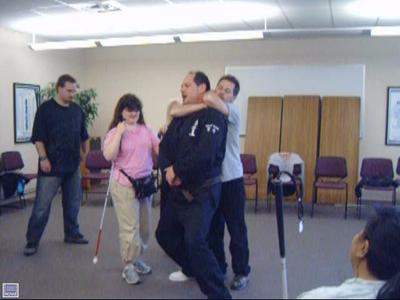
Dave Sharpe (1st Dan) leading
a seminar at the OTC.
Unaware of
the response and through Randy’s encouragement, we designed a short seminar at
this Center. To my amazement and pleasant surprise, there was a great
deal of interest in “Blind Karate”. We were soon teaching 5 to 6 seminars
a year and, as I witnessed, changing lives in the process.
Well, to say that
the first one was a disaster would be an overstatement - but not by much.
As it turns out, there is a big difference in teaching a single blind
student over the course of a few years, and teaching a classroom full of blind
students in a few hours. Yes, Seminar 1, Day 1 did not go smoothly.
As our
experiences with blind students grew, our training styles evolved and improved,
we eventually came to a point where teaching a two day seminar was a ‘no
brainer’. I teach about 75% of the seminar with sleep-shades over my eyes,
which help me be more effective by reminding me that my students are
blind. This forces me to slow down and verbally demonstrate each
technique with thorough word pictures allowing the students to see in their
mind’s eye the moves as they unfolded and the rationale behind it. The
end of the two day class would culminate in a full-speed, live, in-person
attack on each student.
I’m here to
tell you, it is nothing short of amazing to watch the transformation from Day
One - the “I’m blind and I can’t do it and I’m a victim!” to “I’m blind and you
are going to get hurt if you mess with me!!!” The confidence, the
swagger, the self-assured stance, the powerful freedom of knowing that they can
walk down the street and believe – truly, deeply know that they can defend
themselves. This metamorphous is the reason I teach these classes for
free. There is no amount of money that can affect the feeling of
pride I have as I see each student’s progression.
Situational awareness was
a big piece of the pie; getting each student to reach out with their ears and
listen to my voice and foot-steps as I walked around the room, teaching them to
immediately recognize the nature of a grab the moment they are attacked,
helping them to understand the need to fully know their surroundings so they
could make a timely escape. This was all critical stuff, but surprisingly
the single greatest obstacle to overcome was helping them understand, to truly
know, they could do it; and more so, that they were allowed to do it.
I have to admit, this
surprised me a great deal; but upon reflection it started to fit
together. They have all been told they were disabled, somehow flawed in their design, and therefore, by
inference they were less worthy than those around who were fully-abled.
For those students who had
grown-up with some degree of visual problems this psychology ran even deeper,
for as children they had been informed that they couldn't go there, or couldn't
do that (for logical safety reasons of course) because they were blind.
Their whole lives had been defined by their inability to do something, and here
I was telling them they were fully capable of learning a martial art and fully
capable of applying that martial art to self defense. For some, this was
a bit too much to grasp, for others, it became a mantra for their lives.
Another interesting aspect
of teaching self-defense to blind students was learning to overcome what I call
the ‘blind robot gait’. Imagine if you
could not see how your body moves through space, you have to reference for what
your arms and legs are doing at any given moment, and added to this you are
acutely aware of all the little inanimate obstacles laying around the world
that are just waiting to jump out and attack you; slamming into shins and
barking at your ankles, or slapping you firmly in the face. Not fun!
Usually, this isn’t
something we are able to fix over the course of a short weekend seminar, but
for those students who strive to earn a black belt it’s a simple issue of
mind-over-matter; if you don’t mind, it won’t matter.
Randy and I have been
running these seminars for nearly 8 years now, and in all that time I have
never accepted a payment for a class, simply because there is no amount of
money that can compete the sense of accomplishment I have when I see a student
walk into class on Day ; scared, intimidated and totally sure of his or her own
lack of value; then to see them walk out on Day 2, filled with confidence and
the knowledge that not only can they fight back, but that they should fight
back.
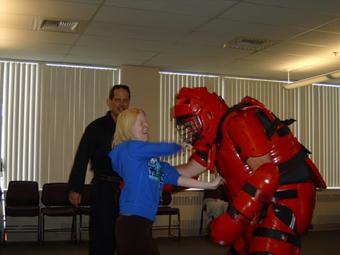
Dan Edwards (in the Redman suit) attacking a student on
Day 2.
David Sharpe is in the background. – Here the student is
using a
kubiton to inflict the maximum amount of damage possible.
Each class begins with a
simple question - what are you willing to fight for? The answers all
vary, but in the end I hardly ever hear 'I am willing to fight for
myself'. It's usually a mix of being willing to fight for a prized
possession, willing to fight for a family member or friend, but painfully rare
is the student who proclaims 'I will fight for myself', 'I will fight for my
safety'. As the class progress and students learn that by using a keen
sense of hearing and touch that they too can fight back, the confidence needed
to use these new-found skills slowly develops.
Day 2 ends with a
full speed, live attack from me (fully protected in my Redman suit of
course!). Each student is brought into the room, one person at a time,
and each student has to face their nightmare - a hulking man intent on doing
them harm, and in these past 8 years and several hundred students, each one has
managed to defend themselves against me; some inflicting some serious damage
that has made me eternally grateful for all that extra padding!
Just recently I had the
honor of awarding a black belt 1st degree to another blind man, David Sharpe;
who has now taken on the mantle of instructor and is going forward with his
efforts to teach other blind people about martial arts.
From Left –
Dave Sharpe (blind), 1st Dan;
Randy Tedrow (blind) 2nd Dan;
Dan Edwards (author) 5th Dan
Prior to being awarded his
belt, David had to demonstrate, to me, his ability to teach CKK to other
students, and so we had him lead a seminar at the blind school in Seattle where
this had all begun so many years ago...The seminar went well, David had a good
time, Randy and I got to watch our protégé spread his wings, and a few weeks
later one of the students had a chance to put into practice the techniques we
had given her.
The situation was not all
that unique; a young woman walking home at night with her boyfriend finds
herself confronted by a group of men with obvious ill-intent. Now is the
part where you are expecting a great and dramatic fight scene, with vicious
kicks, flashing knives and screams of wounded would-be attackers.
Sorry. Didn't go
down like that. Actually, this young woman learned one key point to
self-defense for blind students – Always keep your cool. She took our her cell phone, hit speed dial
for the police, dropped the phone to the ground and stood ready to fight back
if need be; all the while calling out to her boyfriend to tell her what street
she was on, which direction she could run, how many attackers there were, what
landmarks were close by – thus giving the police operator an exact location for
her, and letting her know the best rout for a quick escape.
These days I teach blind
students almost exclusively; I can’t even recall the last time I taught a
sighted class; frankly, it’s just not as much fun.
Watching
David and Randy train, one would never know they are blind. Unless, of
course, you noticed the white cane next to David
or Randy’s guid-dog, Clark, curled up in the corner of the studio. Over
the years, Clark has even gotten used to all the yells and shouts. And we
have destroyed more canes than I care to think about!
Combat Kenpo
Karate for the visually impaired can provide confidence and skills usually
thought out of their reach. It has shown to provide a level of
self-assuredness that is comforting to the student and their loved ones.
If you are interested in learning more about these classes, please don’t
hesitate to contact me via my email, at train4defense@yahoo.com for further
information about time and locations.